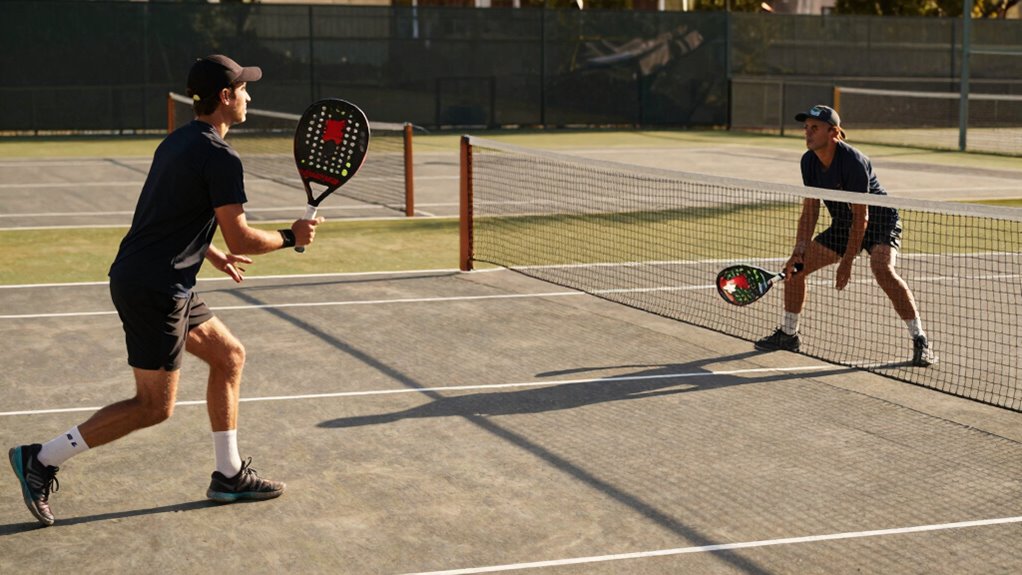
We’ve all been there—showing up ready to play pickleball with just one other person and wondering how to make it work. Good news: singles play is not only doable, it’s a killer way to sharpen your game. The court stays the same—20 by 44 feet—but now you’re covering every inch solo, which means more sprinting, smarter positioning, and yes, a few humbling dives for shots we probably shouldn’t have chased.
Key Takeaways
– Pickleball singles is played one-on-one on a20-by-44-foot court, requiring each player to cover their entire side.- Games are scored to11 points, with the server winning points and needing a two-point lead to win.- The server must serve diagonally into the opponent’s service box, switching sides based on the server’s score.- The two-bounce rule applies: the serve and return must each bounce once before volleying is allowed.- Players use stamina, positioning, and strategy to cover the court, leveraging baseline play and forward movement after dinks.
Understanding the Basics of Singles Pickleball
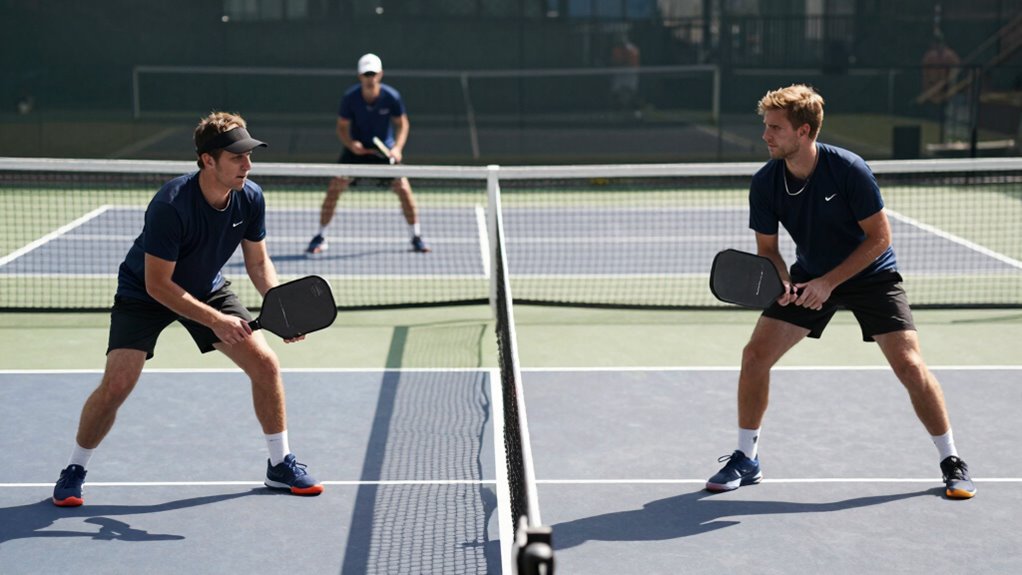
While it might feel strange at first—just two people spread across a 20-by-44-foot court—we’ve found singles pickleball actually sharpens your focus fast.
In singles pickleball, it’s just you and your opponent, both of us hustling to cover the court like we’ve got twice the legs. Only the serving player can score, so when we’re on serve, every point feels like a chance to seize control. We start from the right if our score’s even, left if it’s odd—small rule, big impact.
The game runs to 11, win by two, so stamina and smarts matter. We’ve all misjudged faults—serving too high, skipping the two-bounce rule—then facepalmed mid-game.
Covering the court isn’t about speed; it’s positioning, patience, and not panicking when the ball zips to the far corner. We’ve tripped over our own feet more than once. Proper sole design and traction help you maintain your footing and balance during intense lateral movements across the court.
But mastering the rules, reading your opponent, and staying cool under pressure? That’s how we own the court—and the game.
How Serving Works in Singles Play
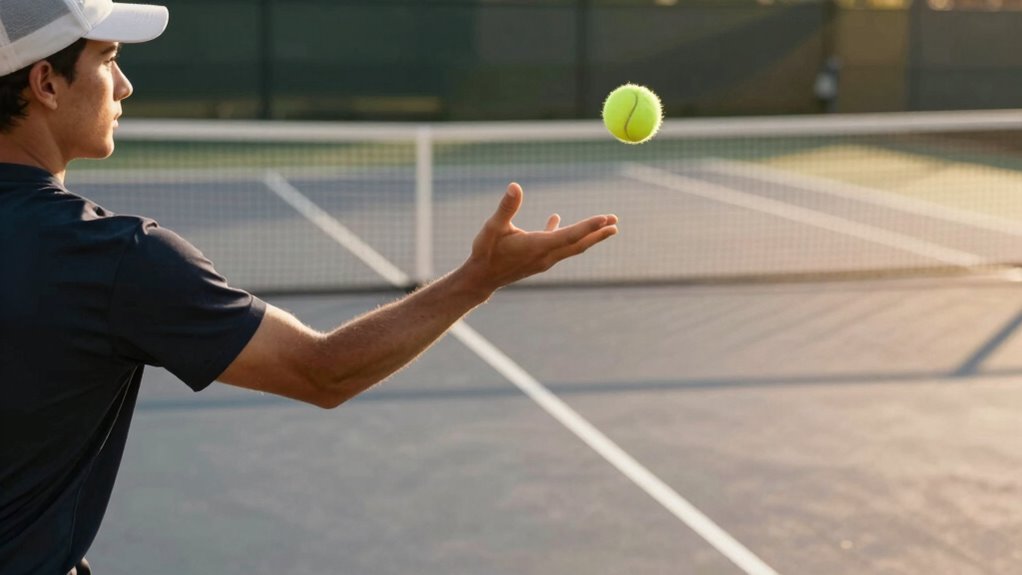
We start every point the same way—with the serve—and it’s our first real chance to set the tone, just like we did back when we were still getting used to covering the whole 20-by-44-foot court on our own. In singles, the serve rules give us control—but only if we play smart.
- We always serve from the right side when our score is even, and switch to the left side when it’s odd—it feels weird at first, but soon it’s second nature.
- Only the serving player can score a point, so when we lose the serve, we’ve got to earn it back through grit and clean returns.
- The serve must land diagonally in the opponent’s service box and clear the non-volley zone—one net brush and we’ve handed them the serve and return edge.
- Just as professional equipment like the Nikon Z8’s autofocus system can give athletes an edge in capturing their best moments, mastering your serve mechanics gives you the competitive advantage you need.
We’ve burned plenty of points over that kitchen line, more than we’d admit.
But now, every serve feels like a quiet act of claiming space—no partners to hide behind, just us, the court, and the next point waiting to unfold.
Scoring Rules Every Singles Player Should Know
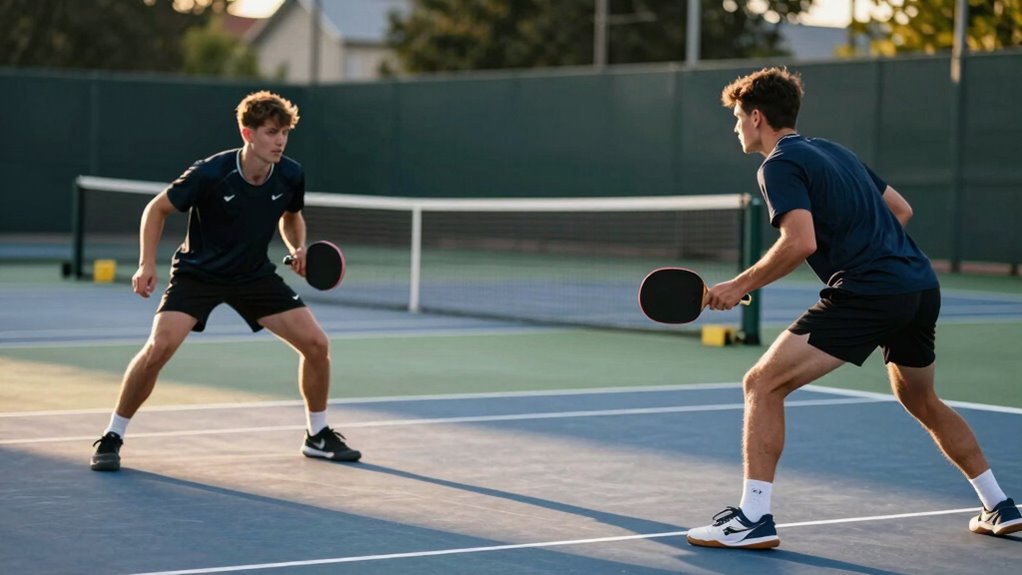
Since the first time we miscounted at 9-all and blew the game on a dumb fault, we’ve learned that scoring in singles isn’t just about tallying points—it’s about managing rhythm and nerves.
In singles pickleball, we play to 11 points, and we must win by two—we’ve seen too many come-from-behind wins to skip that detail. Only the serving player scores, so every serve matters.
When we’re up, our score determines our serve side: right side if even, left if odd—easy to forget when the court’s hot and our heart’s pounding. We call the score server-first, like “6-5,” so there’s no confusion.
If we make a fault while serving? We lose the serve—no points, just a side-out. But if the receiver faults? We grab the point and keep serving.
It’s a rhythm game—serve side shifts, points pile up, and one lapse can flip everything. We stay sharp, count out loud, and own every serve. Staying hydrated during intense matches is crucial, so consider using hands-free hydration to maintain peak performance without breaking your focus.
This isn’t just scoring—it’s strategy, control, freedom.
Common Faults to Avoid in Singles Games
It’s easy to underestimate how fast a sloppy serve can wreck a hard-earned rhythm—just ask us after double-faulting at deuce last summer with our Prince Response 1500 in hand.
We’ve learned the hard way that avoiding faults starts with clean, controlled serves that clear the net and land beyond the non-volley zone line. The kitchen ruins many rallies, especially when we get antsy and volley while standing inside it—don’t do it.
And let’s not forget the Two-Bounce Rule; even seasoned players sometimes rush and hit before the second bounce, killing the gameplay right when it heats up. Proper footwear with moisture-wicking properties helps maintain focus and prevents distractions from sweaty feet during intense singles matches.
- Landing your serve in the non-volley zone? Instant fault—aim deeper.
- Hitting out of bounds or into the net? Check your paddle angle and contact point below the waist.
- Switching the serving side without tracking? New players get tripped up—stay aware.
Own your service motion, respect the Two-Bounce Rule, and keep your feet out of the kitchen—your point streaks will thank you.
Court Dimensions and Positioning Strategies
Pickleball court size doesn’t change just because there are only two of us on the court—still 20 feet wide and 44 feet long, same as doubles—with that 7-foot kitchen lurking on both sides like a trap we’ve both stepped into barefoot one too many times.
These court dimensions mean we each must be fully present, covering your entire side with smart, relentless motion. Singles is more physically demanding than doubles—no partner to lean on, no shared breath—so our strategic positioning has to be on point.
We stay near the baseline to handle deep lobs but creep forward after our own dinks, ready to pounce. When we serve in singles pickleball, players should aim to serve deep and diagonal—right side on even, left on odd scores—to control rhythm.
Try skinny singles sometimes; it forces precision and creates an entirely new challenge. Like portable soccer goals that require stability and safety features, singles pickleball demands that we maintain secure positioning to prevent injuries during intense play. It’ll sharpen reflexes, improve your game, and remind us both why we love this grind.
Trust me, we’ve bled on this court too—now let’s own it.
The Role of the Non-Volley Zone in Singles
When we rush the net too enthusiastically, the kitchen reminds us—fast and unforgiving—why patience matters, its 7-foot boundary stretching across the court like an invisible tripwire we’ve both face-planted over more than once.
In singles pickleball, the non-volley zone isn’t just a rule—it’s a weapon we use to outsmart each other. Players who volley from inside it hand over points with careless faults, so we’ve learned to hover just behind it, using precision over power. Smart shot placement pushes our opponent deep, then pulls them forward, creating openings we pounce on. The court becomes our chessboard, and every move near the zone demands focus. Maintaining ergonomic designs and proper hand positioning near the net helps us execute these delicate shots with consistency and control.
- We fake a net rush, then drop back—watching our opponent misstep into a fault
- We aim soft dinks just over the net, forcing weak returns we can volley safely
- We retreat after aggressive moves, resetting before the non-volley zone claims another victim
Mastering this space isn’t about restraint—it’s about liberation through smarter strategies.
Differences Between Singles and Doubles Play
Though we like to pretend we’ve got it all under control, covering the whole court alone in singles makes us realize—fast—how much ground one person really has to own.
In singles pickleball, it’s just you—no backup, no shared court coverage—so smart player positioning is everything. We’ve all sprinted diagonally only to miss a drop shot—classic.
Doubles, with two players per side, lets us lean on teamwork, split zones, and quick switches, making it feel more like a dance than a sprint.
The game changes fast: rallies in singles are sharper, quicker, while doubles often builds longer, strategic exchanges.
Scoring differs too—singles uses a simple two-number system, while doubles includes a third digit to track both partners’ points.
And forget second serves—singles means you fault, you’re out. No safety net.
We love both, sure, but singles? It strips everything down—just us, the court, and the raw thrill of owning every inch. Solo training with rebound net functionality can help you develop the quick reactions and accuracy needed to excel in singles play.
Mastering the Two-Bounce Rule in Singles
We’ve all stood at the baseline after a long point, heart still pounding, only to blow the next one by smacking the return volley before the second bounce—sigh, there goes the serve again.
In singles pickleball, the Two-Bounce Rule isn’t just a suggestion—it’s freedom disguised as patience. Both players must let the ball bounce once on their side after the serve and return—two full bounces before volleys take flight. Skip it? That’s a fault, and you lose serve.
But when we master it, something clicks: our groundstrokes gain purpose, our movement settles, and strategic play unfolds. Just as grip and control matter in other racquet sports, they’re equally essential in pickleball for maintaining consistency during baseline exchanges.
- The Two-Bounce Rule levels the court—giving us both time to reset and attack fairly
- We use the first bounce to step in, but resist the urge to volley too soon (yes, even when it tempts us)
- Faults drop when we treat serves and returns like chess moves, not sprints
This rule? It’s not holding us back. It’s setting us free to play smarter, not harder.
Tips for Improving Stamina and Court Coverage
If we’re honest, most of us start strong in singles—flying around the court like we’ve got springs in our shoes—only to turn into tired turtles by the third set, barely able to reach the back corners.
We’ve all been there—gasping, limping, wishing the court were half its size. But if we want to improve stamina and dominate the full court, we need real strategies.
First, we commit to cardiovascular exercises—30 minutes of brisk cycling or jogging five days a week builds endurance fast.
We add interval training—30-second sprints followed by 90 seconds of walking—to mimic the bursts we face in singles pickleball.
Twice a week, we hit strength training: squats, lunges, and planks to power our legs and core. That strength sharpens our court coverage and agility.
We run practice drills—shuttling side to side, shadowing every shot—to wire our movements.
And we never skip hydration or solid nutrition—water, electrolytes, lean protein, and complex carbs keep us fueled.
A fitness tracker can monitor your heart rate variability and recovery metrics during these training sessions to ensure you’re working at the right intensity for maximum gains.
When we fuel right and train smart, we’re not just surviving the match—we’re owning it.
Exploring Skinny Singles for Focused Practice
We’re fresh off building our endurance with cardio and strength work—finally able to chase down those cross-court flicks without collapsing—and now it’s time to sharpen what matters most: control.
Playing singles pickleball throws a unique set of challenges at us, but skinny singles? That’s our secret weapon. In this format, players only use the center channel—10 feet wide by 44 feet long—letting us focus on strategic shot placement without getting stretched too thin.
It’s not about covering the court; it’s about owning a sliver of it. We use it to improve your skills where it counts.
- Slow down rallies to refine dinking and volleying with precision
- React faster in tight spaces, training instincts for real matches
- Practice specific skills like spin placement or reset shots—no distractions
Skinny singles strips the game to its core, removing fluff so we sweat the details. Just as breathable fabrics keep cyclists cool during intense summer rides, proper equipment choices in pickleball ensure you stay comfortable while focusing on technique.
We laugh when we mis-hit—again—but that’s the point. Less room means less room to hide. And honestly, that’s liberating.
Frequently Asked Questions
How Do You Play Pickleball With Just Two People?
we play pickleball with just two people by covering the full court ourselves, using standard court dimensions and a simple scoring system where only the server earns points. we serve diagonally with proper serving techniques, split the court in half or play full-court for game strategy, and stay on our toes—literally—to dodge common mistakes like overhitting or poor player positioning. our match duration varies, but we always gain fitness benefits through quick sprints and sharp turns. we only need paddles, a ball, and net access—equipment needed is minimal, so we’re free to play anywhere. by mastering these moves, we reveal both power and freedom on the court.
How Does Singles Pickleball Work?
We flow like tide—scoring to 11, win by two, owning the 20×44 court. Our serve rules, shot selection, and positioning shape game pacing. We respect fault considerations, match etiquette, and smart strategy, liberating every move, one point at a time.
What Is the Format for the Pickleball Singles Tournament?
We follow a bracket setup where the tournament structure uses elimination rounds to crown a champ. Our scoring system demands an 11-point game format with a two-point win. We leverage player seeding, guarantee player eligibility, set match duration, and uphold championship rules for true liberation.
What Is the Difference Between Singles and Doubles Rules?
We see clear differences: our singles strategy demands full court coverage, while doubles divides it. Our scoring system uses two numbers, not three. We serve once per turn, targeting fault areas precisely. We move nonstop, rallies stay shorter, games finish faster, and tournament structure reflects our solo, dynamic style on the same court dimensions.
Conclusion
We’ve danced across these 20-by-44 feet of pavement more times than our knees care to remember—each rally a tiny battle of wills and wits. Pickleball singles isn’t just a game; it’s a mirror, showing us where we’re fast, where we cheat the kitchen line, and where we still chase dinks like lost dreams. But hey, every fault’s a lesson in disguise—and we’ve served enough to know. Keep moving. Breathe. Own your third shot.