
We’ve all felt the sting of not being the star player. Here’s what we’ve learned: your value on a team isn’t determined by your scoring average or highlight reel. Supporting roles—the ones that don’t always show up in stats—often determine whether a team actually wins or collapses. So what makes a non-star player genuinely essential? It comes down to something most of us overlook entirely.
Key Takeaways
- Diverse skill sets and complementary talents create stronger teams than groups of identical players.
- Supporting players learn championship-level decision-making and leadership by observing high achievers up close.
- Defensive efforts, assists, and consistent effort contribute significantly beyond scoring in team success.
- Positive attitude and energy levels can outweigh raw talent in building winning team culture.
- Team members thrive when valued for unique strengths and genuine belonging, not individual heroics.
The Value of Diverse Team Strengths
When you’re standing on the sidelines watching your team stumble through a game, it’s easy to fixate on the star player—the one who seems to carry everything on their shoulders. But here’s what we’ve learned: our team would actually perform better when we stop chasing that myth. Diverse strengths—not uniform excellence—create winning combinations. We’ve watched squads with varied skill sets outperform homogenous groups consistently. That defender who reads plays brilliantly? The communicator who rallies morale? The strategist orchestrating movement? They’re equally essential. Collaboration means recognizing that you don’t need identical talents; you need complementary ones. Research confirms diverse teams bring different perspectives, sparking creativity and innovation. When each person owns their specific strength—whether leading or supporting—we’re collectively unstoppable. That’s liberation: freedom from the impossible standard of being everything. Studies show that diverse teams bring different perspectives, enhancing problem-solving and decision-making in high-pressure situations.
Learning From Winning Teams as a Supporting Player

As supporting players on winning teams, we’re actually positioned in one of the best classrooms available—and most people don’t realize it. We observe championship-level decision-making up close, studying how the best player operates under pressure. That’s invaluable intel you won’t find in any high school textbook.
We’re absorbing resilience in real-time, watching leaders navigate setbacks without crumbling. Next time you feel overlooked, remember: you’re learning leadership styles you’ll eventually implement. We’re building networks with high-achievers who’ll become our future collaborators and advocates. Like progress tracking and analytics that help visualize improvements, observing how elite performers monitor their development teaches us the importance of data-driven self-assessment.
The winning culture we’re embedded in teaches adaptability—responding to what works rather than forcing predetermined plays. We’re not just playing alongside excellence; we’re reverse-engineering it. That education prepares us for leadership roles where being the best player matters far less than understanding how teams actually succeed.
Developing Leadership Skills on Struggling Teams
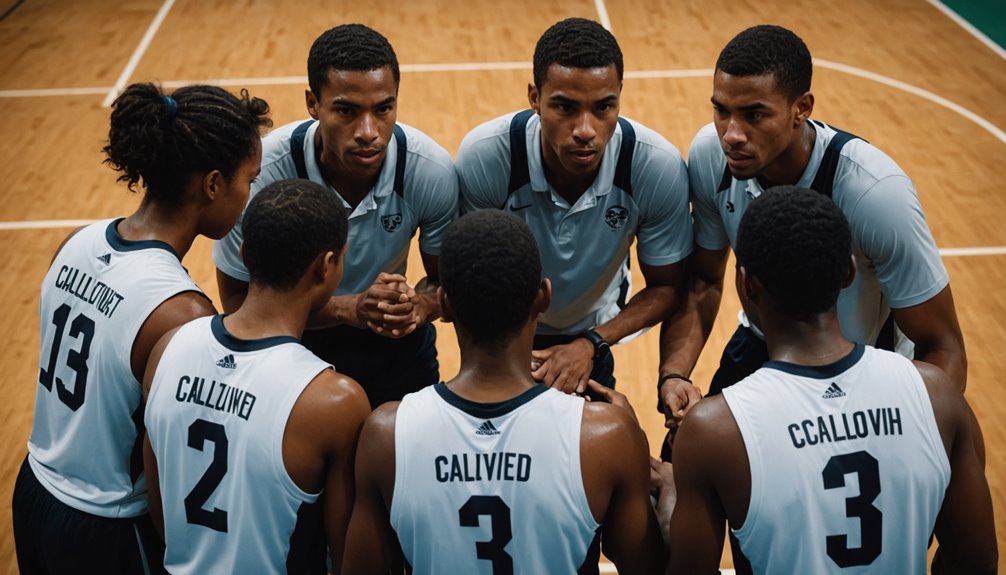
Being the best player on a winning team teaches you what excellence looks like—but being the leader on a struggling team teaches you what leadership actually is. We can’t really grow without pressure, even though it might feel overwhelming at first.
When your team’s struggling, you’ll develop irreplaceable skills:
- Problem-solving under fire — adapting strategies based on real-time feedback from teammates
- Emotional intelligence — reading the room and adjusting your approach accordingly
- Resilience building — bouncing back after losses and maintaining team morale
- Authentic motivation — inspiring others through genuine connection, not just talent
You’re learning that leadership isn’t about being the flashiest player. It’s about fostering unity, steering through challenges together, and understanding collaboration’s power. Proper equipment like quality sports gloves can also boost your teammates’ confidence and comfort during difficult stretches, allowing them to focus on improvement rather than discomfort. These hard-won lessons? They’ll shape every leadership role you’ll ever take on.
Beyond Scoring: Measuring Performance in Multiple Ways
If you’ve ever watched a game where the leading scorer got a standing ovation while the player with eight assists sat quietly on the bench, you’ve seen how distorted our measurement of success can be.
We’re breaking that ceiling. Real performance extends beyond points—it’s about assists impact, defense strategies, and teamwork dynamics working together. Here’s what actually matters:
| Metric | Traditional View | Liberated View |
|---|---|---|
| Assists | Secondary stat | Primary creator |
| Defense | Invisible labor | Game-changing impact |
| Effort | Expected minimum | Cultural foundation |
We’ve learned that the quietest players often anchor everything. They execute defensive schemes, facilitate plays, and elevate teammates’ performance. Just as adjustable protective gear accommodates growing athletes and encourages consistent participation in youth sports, flexible team roles allow players to develop their strengths and contribute meaningfully. Coaches recognize this—they’re building winning teams through collective contribution, not individual heroics. You’re valuable precisely because you’re not chasing scoring records.
The Role of Effort and Attitude in Team Success
You’ll notice something striking when you watch championship teams play: the players who elevate everyone around them rarely lead the stat sheet. Here’s what we’ve discovered matters most:
- Effort recognition—coaches notice who shows up ready to work, and that consistency opens doors
- Attitude adjustment—shifting from “what about me?” to “how do I help?” transforms team chemistry
- Morale boosting—your energy either drains or energizes teammates; there’s no neutral
- Culture building—one person’s commitment to excellence ripples through the entire roster
We’re not saying talent doesn’t matter. It does. But we’ve seen countless rosters where the hardest workers became the glue holding everything together. Your attitude directly influences whether teammates push harder or give up. That’s real power—the kind that wins championships, even if your name never tops the scoreboard. Just as spatial audio enhances immersion in fitness games by keeping athletes engaged during workouts, your consistent presence and positive attitude creates an immersive environment that keeps your teammates mentally and emotionally invested in the team’s mission.
Building Team Chemistry Through Unselfishness
The attitude piece we just covered? It’s the foundation, but here’s where the magic happens—building genuine team chemistry through unselfishness. We’ve learned that when you prioritize collective goals over personal highlights, trust building accelerates dramatically. Your teammates notice. They reciprocate.
Strong team communication flourishes when players stop competing for spotlight. Instead, you’re actively supporting each other’s development—celebrating assists over points, recognizing the defender’s vital stop, acknowledging the backup’s preparation. This isn’t naive idealism; it’s strategic wisdom. Teams prioritizing unselfishness exhibit measurably higher morale and resilience during pressure moments.
We’re talking real liberation here: freedom from ego’s exhausting performance. When you embrace your role—whatever that role demands—you reveal collective potential that no individual talent can replicate. Just as reinforced stitching at stress points prevents equipment failure during high-pressure activities, reinforced commitment to team roles prevents the breakdown of chemistry when challenges mount. That’s the unfair advantage unified teams possess.
Equity, Growth, and Long-Term Career Development
Most people fixate on ownership percentages and individual accolades—we’ve all done it—but here’s what we discover once we’re actually in the room with winning teams: that 1% stake in a thriving $500M company outperforms 100% ownership of a failed venture every single time.
Equity dilution stings initially. We get it. Yet consider what we actually gain:
- Networking opportunities that compound over years, opening doors we couldn’t solo
- Career resilience built through winning alongside relentless achievers
- Accelerated skill development that transfers to every future venture
- Access to excellence—learning systems and strategies from proven leaders
When we release our white-knuckled grip on control, we liberate ourselves to grow. Just as smart sensors optimize performance by detecting unnecessary operations and pausing to conserve resources, we too must recognize when our individual control mechanisms waste energy better directed toward collective momentum. That 1% becomes our launchpad, not our consolation prize.
Overcoming Comparison and Focusing on Personal Growth
When we stop measuring ourselves against the highlight reel of the best player on our team, we actually start getting better—counterintuitive, I know. Here’s what we’ve discovered: self-assessment strategies beat external comparisons every single time. By tracking our own progress through personal benchmarks—not someone else’s stats—we reclaim our power. We’re no longer chasing shadows.
A growth mindset thrives on this freedom. We ask ourselves honest questions: Where was I last month? What’ve I improved? These internal markers matter infinitely more than being second-best at everything. We each bring distinct strengths. When we stop fighting for the crown, we actually contribute more authentically to our team. Just as versatile equipment allows athletes to focus on their individual progress rather than expensive specialty gear, tracking personal benchmarks lets us measure what truly matters—our own development.
This shift isn’t weakness—it’s liberation. We’ve found that focusing inward fuels motivation and genuine achievement. That’s the real win.
Creating a Supportive Culture That Elevates Everyone
Once we’ve figured out our own lane, we’re ready to build something bigger—a team environment where everyone’s got real skin in the game. That’s where team empowerment happens.
We’ve learned that a collaborative environment thrives when we actively recognize each other’s contributions:
- Acknowledge effort over outcomes—celebrate the grind, not just the wins
- Create space for mutual recognition—let teammates lift each other up consistently
- Value diverse strengths—different skills matter equally to team success
- Foster genuine belonging—make people feel needed, not just tolerated
When we shift our mindset from individual achievement to collective elevation, something shifts. People perform better. They take risks. They show up differently knowing their teammates have their backs—even on bad days. This strategic approach mirrors how proper gear selection creates the foundation for success in group activities, ensuring everyone has what they need to contribute effectively. This isn’t soft management; it’s strategic. Supportive cultures outperform competitive ones because everyone’s invested in everyone else’s growth. That’s liberation.
Frequently Asked Questions
Can You Be Independent and a Team Player?
Yes, we can absolutely be independent and team players. We’re embracing our individual strengths while cultivating a collaborative mindset. We’ll support each other in our roles, recognizing that our independence fuels our collective freedom and power.
Do You Consider Yourself to Be a Team Player?
We’re absolutely team players—research shows 86% of employees cite collaboration as essential to success. We’ve cultivated a collaborative mindset, embraced supporting roles, and mastered effective communication, empowering ourselves and others to break free from competitive constraints.
Can a Player Refuse to Play for a Team?
Yes, we can refuse to play for a team. Our player rights matter—we’ve got participation agreements that protect us, and team dynamics shouldn’t force us into situations that violate our principles or well-being. We’re free to choose what serves us best.
Is It Okay to Not Be a Team Player?
No, it’s not okay. We can’t succeed when we’re not embracing team dynamics, we can’t grow when we’re ignoring personal goals’ alignment, and we can’t thrive when we’re denying our contribution value. Freedom comes through collaboration, not isolation.
Conclusion
We’ve learned that being the best player isn’t what makes a team win—it’s what we *do* with our role that matters. Consider a college basketball team where the point guard averages 8 points but orchestrates 12 assists nightly; that’s impact. We build championship cultures by embracing our strengths, supporting teammates relentlessly, and understanding that collective growth beats individual glory. Your value extends far beyond stats.