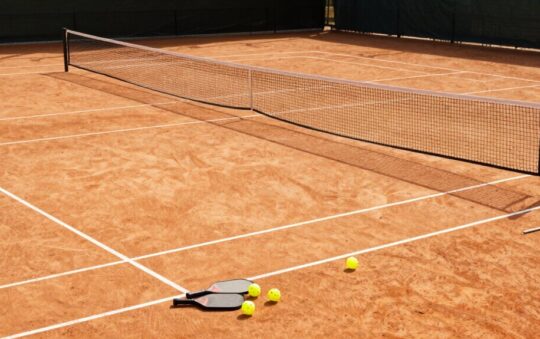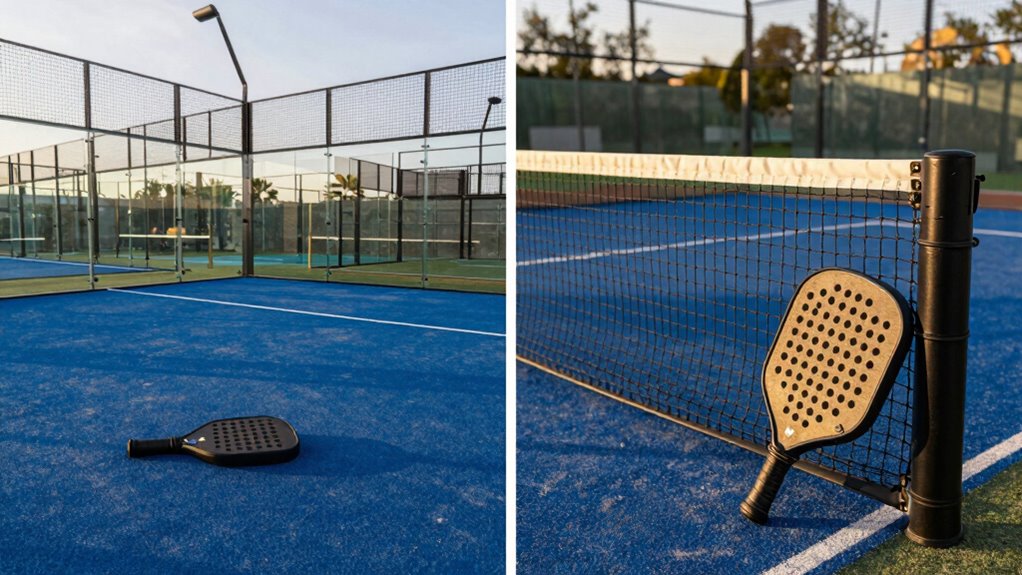
We’ve both stepped onto the wrong court before—me swinging a padel racket like a tennis pro, only to realize the ball bounced off a wall I didn’t expect. Sound familiar? Padel and pickleball might look similar from afar—both fast, social, and wildly addictive—but they’re worlds apart in design and play. You’d be surprised how much a few feet of court space or a slightly heavier ball can throw off your game. Let’s clear up the confusion—starting with where you actually stand when serving.
Key Takeaways
- Padel is played on a 20m x 10m enclosed court with glass and mesh walls; pickleball uses a 44ft x 20ft open court with no walls.
- Padel rackets are perforated and made of carbon fiber; pickleball paddles are solid, flatter, and often wooden or composite.
- Padel allows wall rebounds during play; pickleball does not use walls and relies on direct shot exchanges.
- Padel follows tennis-style scoring (15, 30, 40, games, sets); pickleball uses rally scoring to 11 points, win by two.
- Padel is doubles-only; pickleball supports both singles and doubles formats with a 7-foot no-volley zone.
Court Dimensions and Enclosure Design
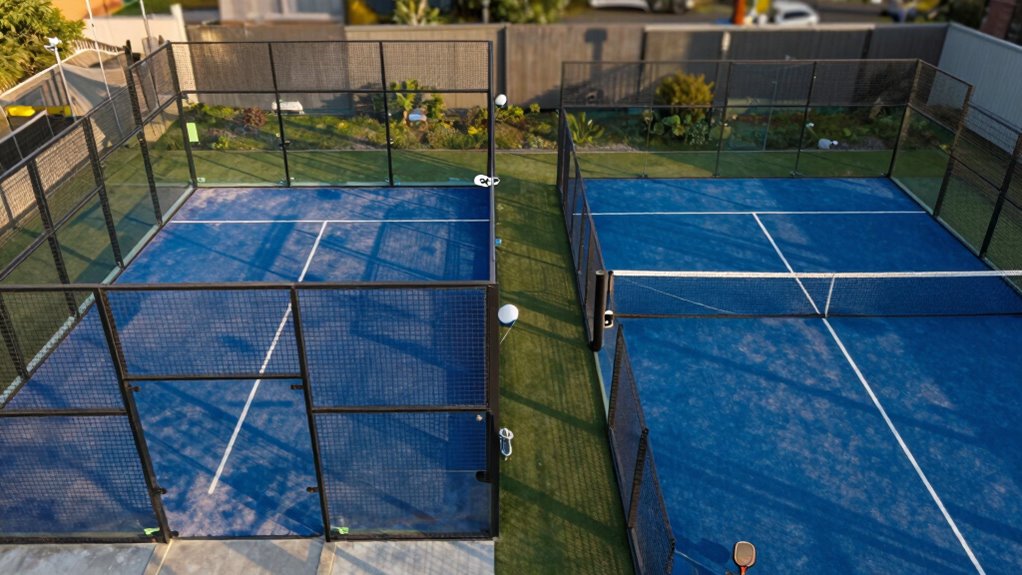
Let’s start with the court—because if you’ve ever shown up to the wrong one with your racket in hand, you know it’s kind of a big deal. We’ve all been there—showing up ready for wall play, only to find an open layout glaring back.
A padel court is an enclosed court, measuring 20m x 10m, lined with glass walls and wire mesh, making rebounds part of your doubles game strategy.
Pickleball court dimensions? Smaller—just 44ft x 20ft—open layout, no walls, totally flat and freeform. No ricochets, no bounces off the glass walls—just clean, direct rallies.
That wall play in padel changes everything—it’s like having an extra teammate. But pickleball keeps it simple, accessible, easy to toss a net in a driveway.
Enclosed court setups need space and cash—padel’s construction is no joke. We once tried converting a tennis court and gave up halfway. The material thickness and durability required for padel court construction demands higher-quality materials that withstand repeated impact and weather exposure.
Still, if you crave dynamic, cage-like energy, go padel. If freedom and flexibility call to you—pickleball answers.
Both have their place—just know which court you’re stepping onto.
Net Height and Serving Positioning
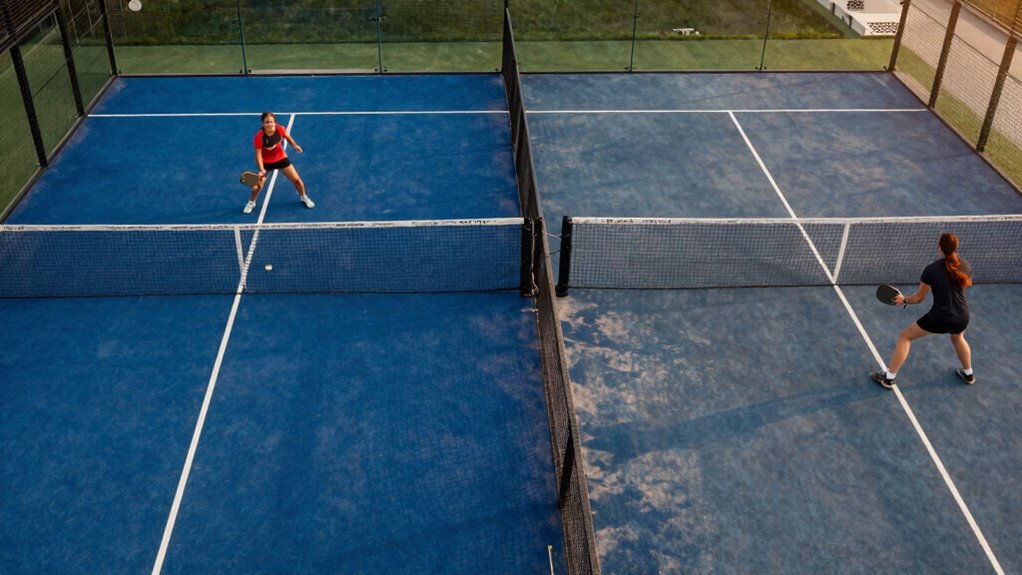
When we first tried switching between padel and pickleball, the net height threw us off more than we expected—36 inches at the posts, sure, but pickleball dips to 34 inches in the center while padel only sags to 35, a small gap that makes a big difference when you’re leaning into a serve.
We quickly learned that serving in pickleball demands precision—its underhand serve must clear the lower middle net while landing beyond the kitchen area, where no volleys are allowed.
In padel, we use an underhand serve too, but the ball must bounce in the service box before hitting the back wall—adding a layer of strategy.
Pickleball lets us drop serve or swing serve, but only one try per point. Padel gives two serves, like tennis, which keeps rallies going.
We’ve missed more serves than we’d admit, especially when we forget the kitchen area rules or confuse the bounce requirements. Understanding autofocus capabilities in sports photography has taught us how precision mechanics matter across different disciplines.
Mastering both means respecting these subtle—but crucial—differences in net height and serving rhythm.
Keep your eyes up, your swing loose, and remember: liberation lives in the details.
Padel and Pickleball Equipment Compared
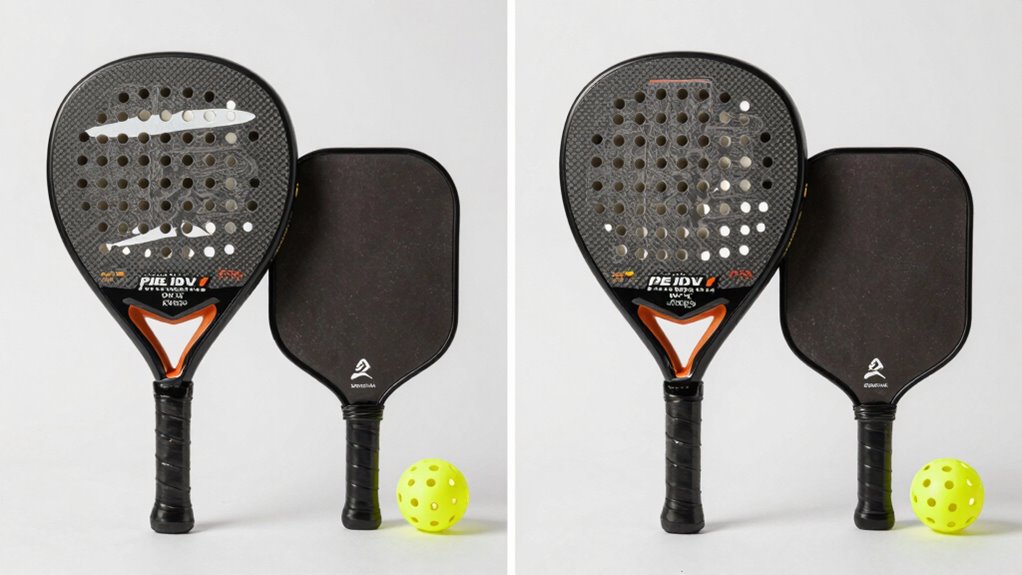
Two things became painfully clear during our first mixed weekend of padel and pickleball: we were using the wrong gear, and it showed in every mis-hit and awkward swing.
When you immerse yourself in equipment compared, the differences aren’t subtle—they shape how you play. Here’s what we learned:
- The padel racket is solid and perforated, around 18.9″ x 10.2″, made from carbon fiber or fiberglass for durability and impact absorption—unlike the pickleball paddle, which is flatter, lighter, and capped at 24″ long.
- We grabbed a tennis ball for padel—smart, since it’s slightly depressurized for lower bounce—while the pickleball uses a perforated plastic ball with 26–40 holes for controlled flight.
- We missed the wrist strap on our padel rackets during quick volleys; pickleball paddles don’t have them, relying purely on grip and flat-surface precision.
- Proper protective gear, including wrist guards with firm splints, becomes essential when playing either sport to prevent injuries during falls and awkward movements.
Our swings finally synced once we respected the construction. Liberation starts with the right tool in hand—don’t wing it like we did.
Racket and Paddle Construction Differences
We walked onto the padel court that Saturday morning still nursing our bruised egos—and aching arms—from the day before, when we’d tried playing both games with the wrong sticks in hand. Swinging a pickleball paddle like a tennis racket? Painful. Using a padel racket to smack that lightweight *plastic ball*? Like hitting air with a sieve.
Here’s what we learned the hard way:
| Feature | Padel Rackets | Pickleball Paddles |
|---|---|---|
| Material | Carbon fiber, fiberglass | Wood, composite |
| Surface | Perforated | Solid face |
| Size | 18.9″ x 10.2″ x 1.5″ | Up to 24″ long, 8″ wide |
| Wrist Straps | Yes—keeps it secure | Rare—risk losing it mid-swing |
| Feel on Impact | Controlled, quiet thud | Crisp, solid pop |
We finally felt free—once we matched the gear to the game. Padel rackets let us glide, spin, and control with those handy wrist straps, much like how shock-absorbing midsoles enhance the performance of athletic footwear on demanding surfaces. Pickleball paddles gave us power and precision with their solid face. Use the right tool. Your arms—and ego—will thank you.
Type of Ball Used in Each Sport
The ball’s the first thing that’ll clue you in to how these games play—get the wrong one, and you’ll feel like you’re spiking a water balloon. We’ve been there, tossing a pickleball like a tennis ball and wondering why it died mid-air. The key differences start with design and explode into gameplay dynamics.
- The padel ball looks like a standard tennis ball but’s less pressurized—its bounce is tamer, perfect for wall play, and it must survive rebounds off enclosed courts.
- A pickleball ball is hollow, plastic, with 26–40 holes—different shapes affect flight, creating drag that slows the game and demands finesse.
- Though both are lighter than standard tennis balls, the pickleball (0.78–0.935 oz) feels substantial compared to a wiffle ball, yet still floats more than you’d think.
- Like durable outdoor equipment that requires precise flame control for optimal performance, both padel and pickleball demand the right equipment calibration to truly master the sport.
We mix them up once—you’ll never forget the difference. The wrong ball kills rhythm, but the right one? It frees you. When the ball must behave just right, everything clicks.
Serving Rules and Techniques
You’d think after butchering a few serves we’d learn—turns out, the ball’s not the only thing that trips you up when switching between padel and pickleball.
In padel, we use an underhand serve below the waist, and the ball must bounce in the service box before hitting the wall—no wall, no point. It’s wild how those rebounds create unique angles, letting the serving team score with sneaky spin and placement. We get two tries, so there’s room to recover from a shaky first serve.
Pickleball, though? One serve attempt, no second chances. Same underhand motion, same diagonal serving pattern into the opposite service box, but here the ball can’t touch the wall—clean and direct. We’ve learned to control the serve with soft hands, using drop serves to keep opponents guessing.
No wall means less chaos, but precision becomes everything. Whether we’re banking off the wall or aiming dead diagonal, mastering serve placement liberates our game. Trust us—once you nail that perfect serve, boundaries don’t feel so limiting. Just as sealed closures protect equipment in sports gear, proper serving technique protects your competitive edge.
Scoring Systems and Game Structure
Though we’ve lost count of how many times we’ve argued over scorekeeping mid-rally, getting the scoring right keeps the game moving—and our friendships intact.
The scoring systems in padel and pickleball couldn’t be more different, and once we learned them, we finally stopped accusing each other of cheating.
1. Padel sticks to traditional tennis rules: points go 15, 30, 40, and games are played as sets—you’ve got to win six games to take a set, but you’ve also got to win by two.
Matches are usually best-of-three sets, with a tiebreaker at 6-6.
2. Pickleball? Simpler. Games are played to 11 points (sometimes 15 or 21), and you must win by two.
Only the serving team can score, which trips up new players.
3. In padel, both teams can score regardless of serve—freedom we didn’t know we needed. Much like how RFID-blocking compartments in travel gear protect against digital theft, understanding these scoring differences protects you from confusion on the court.
No-Volley Zones and Wall Usage
While we were busy arguing over the score, we almost missed how much easier it’s to play defense in padel—thanks to the walls. The court is enclosed, so the ball can bounce off the walls and still be in play, giving us more chances to return shots and create longer rallies.
We can volley anywhere, as long as the ball bounces first—no no-volley zone to restrict us. That freedom opens up wild strategic opportunities you just don’t get in other paddle sports.
In pickleball, that 7-foot kitchen zone keeps us from charging the net too fast. We’ve learned the hard way—stepping in to volley too soon means a fault. But that rule forces smarter shot placement and patient play.
Pickleball’s open court demands precision near the kitchen zone, while padel lets us use the walls like rebounding allies. We’ve used side walls to flick drop shots that surprise even our best opponents.
Whether bouncing off glass or landing softly in the kitchen, both games challenge us—in different, liberating ways. Much like how immersive technology enhances engagement in fitness activities, the strategic depth of these paddle sports keeps players motivated and invested in improving their skills.
Singles Vs Doubles Play Formats
Teamwork isn’t just helpful in padel—it’s mandatory. Padel is *played as doubles*—no exceptions—so we’re always in it together, feeding off each other’s energy and positioning.
Pickleball? We’ve got freedom: it’s *played in both singles and doubles*, letting us choose our rhythm. When we chase liberation on the court, consider this:
- Padel doubles thrive on *utilizing the walls*—we rebound shots like partners in rebellion, turning defense into surprise attacks.
- Pickleball’s *non-volley zone* demands patience—our *quick reflexes* shine, but we risk faults if we’re overeager.
- Doubles in both sports bring *faster-paced rallies*, yet their *court layouts* shape how we move—padel’s smaller box fuels chaos, while pickleball lets us breathe between strikes.
- Padded shoulder straps on sports equipment bags enhance comfort during transport to and from matches, ensuring we arrive ready to perform.
We track the *team’s score* with pride—every point earned through sync, not solo heroics.
Sure, I’ve tripped over my own feet diving for balls (more times than I’ll admit), but that’s the joy. We’re not just playing a game—we’re building something alive, loud, and gloriously unpredictable.
Gameplay Strategy and Athletic Demands
When we step onto the padel court, we’re not just swinging at a ball—we’re setting traps, using every wall like a secret weapon to bend shots where our opponents aren’t.
Padel’s gameplay strategy thrives on tactical complexity—longer rallies unfold thanks to the larger court size and smart wall rebounds, demanding quick reflexes and constant coordination in doubles play. We’ve got to anticipate angles, control pace, and stay light on our feet; the athletic demands are real, turning each match into a full-body chess match with sprints.
Pickleball, by contrast, strips things down—smaller court, lighter ball, slower pace. It rewards finesse near the non-volley zone (“the kitchen”), where quick reflexes matter, but endurance takes a backseat.
Sure, pickleball’s stop-start nature keeps hearts pumping, but we’ll admit—we still gasp mid-rally playing padel after back-to-back wall exchanges. For serious padel players looking to maximize training efficiency, automatic ball return systems can significantly reduce downtime between drills and allow for more repetitions during practice sessions.
Doubles play dominates padel, deepening the teamwork element, while pickleball welcomes both singles and doubles, offering freedom to play hard or relaxed.
Court size alone changes everything—padel pushes us; pickleball pampers us. Both liberate us in different ways—just know which thrill you’re chasing.
Frequently Asked Questions
What Are the Key Differences Between Pickleball and Padel?
We see the key differences in court dimensions, ball types, and scoring systems—we play padel on smaller, enclosed courts with less bouncy balls, while pickleball’s open courts, plastic perforated balls, and 11-point games shape unique shot techniques and freedom in fast-paced play.
Is Padel Harder Than Pickleball?
We’ve found 78% of players say padel’s tougher—we tackle bigger courts, faster rallies, and wall rebounds, demanding higher fitness, sharper strategy, and quicker adaptation, making skill level comparison, learning curve, and court dimensions impact far more intense than pickleball’s easier entry.
What Is Padel Called in the USA?
We call it padel across the USA—no translation, no twist. Padel terminology stays true to its roots, blending into American sports culture while rising in padel popularity. We’re claiming this racket sport as our own, reshaping recreational activities with every match, using padel equipment that honors its rich padel history.
Which Court Is Bigger, Padel or Pickleball?
We understand the padel court is bigger, and we embrace that freedom—its spacious court dimensions reshape game strategy, player positions, and ball types, letting us explore dynamic play on glass-walled surfaces while scoring systems, net height, and player equipment reflect our evolving, liberated sport.
Conclusion
We’ve played both—and trust us, smashing a pickleball with a lightweight paddle feels nothing like launching a padel drive off the back wall. Take last weekend: our team switched courts, and Greg nearly dove into the wall—*twice*—forgetting pickleball’s open play. Padel’s 33-by-20-foot enclosure changes everything. Pickleball’s kitchen rule humbles us all. Bottom line? Try both—you’ll sweat, laugh, and finally grasp why wall rebounds beat chasing balls into the neighbor’s yard.