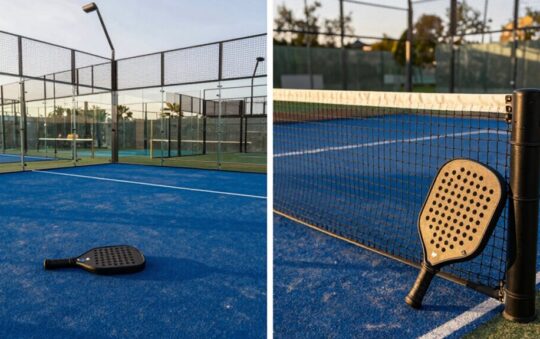
Funny how we built a tennis court in our backyard only to realize—six months later—pickleball’s been taking over every local park. We stood there, tennis rackets in hand, watching couples rally with tiny paddles and perforated balls, scratching our heads. Turns out, those courts aren’t interchangeable—not really. And once you see the differences, you can’t unsee them. Your game might depend on knowing why.
Key Takeaways
- Pickleball courts are 20 by 44 feet, significantly smaller than tennis courts, which measure 78 by 36 feet.
- The pickleball net is 34 inches high at the center, 2 inches lower than the 36-inch tennis net.
- Pickleball courts feature a 7-foot non-volley zone on each side, unlike tennis courts with no such restriction.
- Pickleball requires hard, consistent surfaces like concrete or asphalt for predictable ball bounce and player control.
- Only the serving team scores points in pickleball, and matches are typically played to 11, differing from tennis scoring.
Court Dimensions and Layout
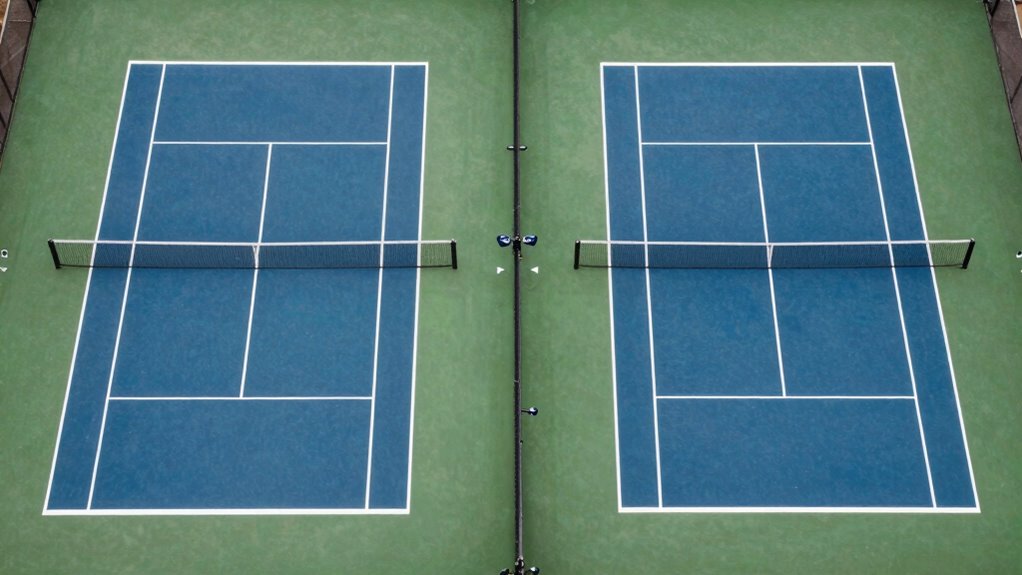
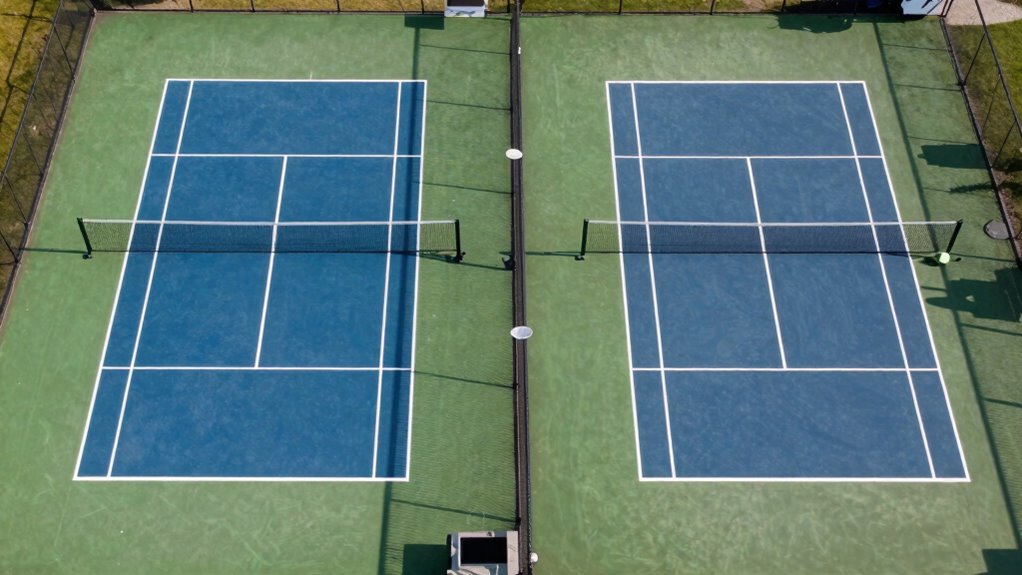
You’d be surprised how much smaller a pickleball court feels when you’re used to chasing down tennis volleys—our first game on a 20-by-44-foot surface left us tripping over our own rhythm, used as we were to tennis’s sprawling 78-foot length.
The court dimensions shrink the battlefield fast. A standard pickleball court is only 20 feet wide—narrower than a tennis court’s 27 feet, even in singles play. We kept lunging out of bounds, swearing we’d space.
But here’s the liberation: four pickleball courts can fit where just one tennis court stands. That compact size changes everything. The non-volley zone—dubbed “the kitchen”—stretches 7 feet from the net on each side, a rule-enforced peace zone we kept accidentally violating.
At first, it felt restrictive. Now, we see it: less running, more strategy. The surface used? Same hard stuff as most tennis courts—concrete or acrylic—but that tight layout means every inch matters. The smaller court dimensions also make pickleball more accessible for athletes of varying fitness levels and ages compared to the demanding distances of tennis.
We moved from frustration to finesse once we stopped treating it like mini-tennis. It’s not about power. It’s precision. And yeah, we still miss-hit into the kitchen. Old habits, man.
Net Height and Design
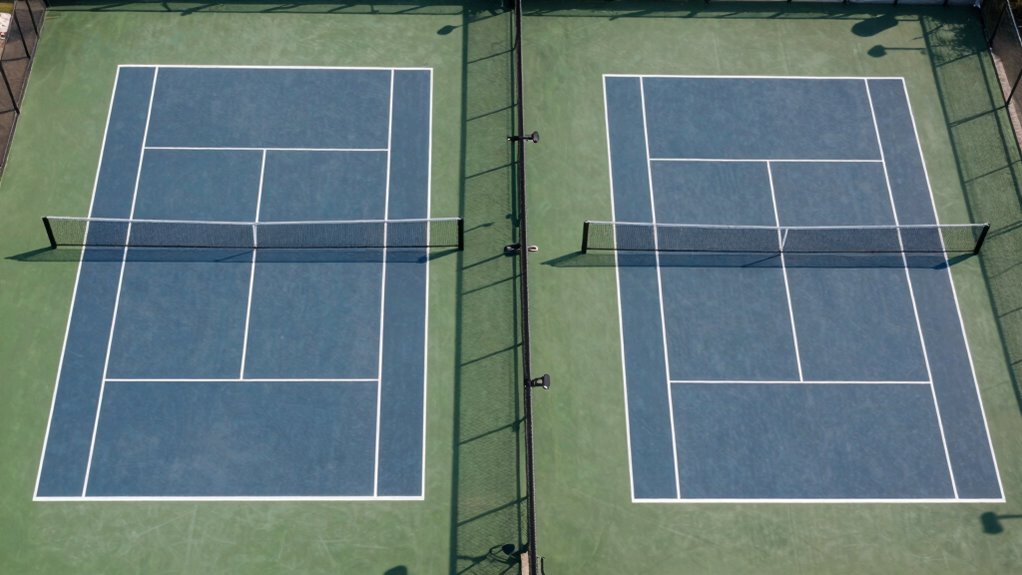
The drop in net height hits you the first time you swing—ours did, anyway, when we tried to crush an overhead like we’d on a tennis court and watched the ball sail long. The pickleball net sags to 34 inches in the center—2 inches lower than a tennis net’s 36—and that small drop changes everything.
We stopped swinging like maniacs once we realized: this isn’t about power. The lower net height, combined with the smaller court size, creates a lower bounce and demands smarter shot strategies—dinks, drop shots, sharp angles. It’s liberation from brute force.
The net’s design also shapes gameplay dynamics, especially with that seven-foot non-volley zone staring up at you. Players can’t just camp at the net like in tennis—no, sir. That restriction, paired with the shorter reach across the court, keeps rallies alive and favors control over crush.
Just as multi-functional gear enhances minimalist camping by reducing bulk while maintaining performance, the pickleball net’s design optimizes gameplay by reducing unnecessary complexity while demanding greater strategic thinking. We now see it for what it is: a precision game disguised as simple fun—net height included.
Non-Volley Zone Presence
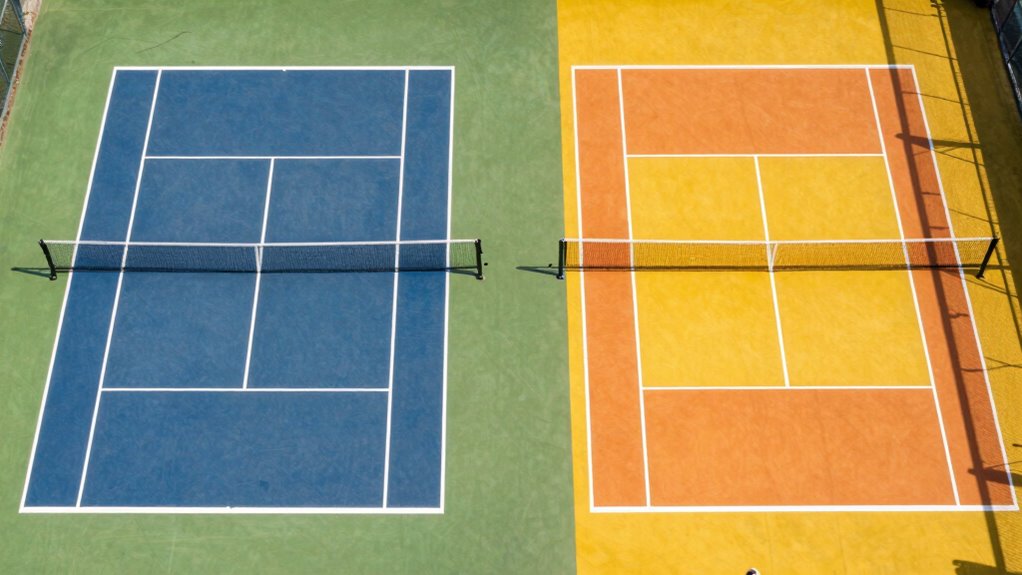
Though we didn’t realize it the first time we charged the net like tennis players on caffeine, that 7-foot no-man’s-land—aka “the kitchen”—is where many pickleball matches are really won or lost.
Unlike tennis, pickleball’s non-volley zone stops us from smashing volleys from right up at the net. Stepping into the kitchen while volleying? That’s a fault—and we’ve all done it, more than once.
This rule changes everything. It forces us into smarter, more patient strategic play, trading raw power for finesse and placement. Even our serve has to clear the non-volley zone—land in the kitchen, and it’s a fault, no second chances.
On the pickleball court, this design boosts accessibility, letting beginners compete without being crushed by aggressive net play. The kitchen isn’t a restriction—it’s liberation in disguise. It keeps rallies longer, encourages movement, and levels the court. Similar to how proper sizing affects comfort in outdoor gear, understanding the kitchen’s positioning enhances your court awareness and tactical positioning.
We’ve learned the hard way: respect the kitchen, and it’ll reward us. Forget tennis-style net dominance. Here, control wins.
Surface Material and Playability
Three things we learned fast after switching from tennis to pickleball: the ball bounces lower, the court feels tighter, and—surprise—the surface under our feet makes all the difference.
Tennis courts vary—grass, clay, or hard surfaces—each altering how tennis balls skid or spring. But pickleball thrives on consistent hard surfaces like asphalt or concrete, keeping the plastic balls low and predictable. That’s key for playability on a smaller court where every inch counts.
Our first few games on cracked tennis pavement? Brutal. The bounce turned wild, turning rallies into chaos. Pickleball’s surface material isn’t fancy, but it’s intentional—engineered for control, not speed. Unlike tennis balls, which need grip and pop, our lightweight plastic balls demand truer, flatter rebounds.
We’ve played on repurposed tennis courts painted down to 20 by 44 feet—fitting three pickleball courts where one once stood. That adaptability? Liberation. No more reserving clay hours or dodging dew on grass.
For optimal performance, the playing surface should have good reviews regarding durability to ensure consistent ball behavior and player safety across multiple games and seasons. We’re out here, moving freely, because the right surface material keeps gameplay smooth, fair, and fast—exactly how we like it.
Scoring and Service Lines
We finally stopped arguing about the score halfway through our first pickleball match on a converted tennis court—turns out, we’d been playing with tennis rules and wondering why nothing made sense.
In pickleball, only the serving team scores points—no alternating points like in tennis—and games go to 11 with a two-point margin of victory, not love, 15, 30, deuce.
We’d to relearn the scoring system fast, especially calling out our own score, then the receiver’s, plus the serve number—such a shift from just yelling “30–15.”
The smaller court size means less running, but the non-volley zone—aka the kitchen—changes everything: you can’t volley near the net, forcing softer shots.
And unlike tennis, where the service line is deep behind the baseline, pickleball’s service line sits just 7 feet from the net—shorter reach, bigger strategy.
We kept serving too hard, forgetting only one side accumulates points.
Incorporating RFID-blocking compartments into your pickleball gear bag can protect your valuables while you’re focused on the game.
Once we embraced these differences—no more arguing, just rallying—we finally felt free.
Equipment Compatibility and Use
Since switching from tennis to pickleball on our local converted courts, we’ve learned the hard way that gear matters—our old tennis rackets felt like overgrown boats in our hands, totally wrong for the lighter, quicker game we were trying to play.
Pickleball paddles, weighing just 7 to 9 ounces, give us way more control—no more swinging at air like we’re chopping wood. Tennis rackets, built for power at 11+, are overkill here.
The plastic ball, light and hole-pocked (26 to 40 holes), floats differently, bouncing lower and slower—perfect for fast exchanges near the net.
We’d to adjust the net height to 34 inches in the center, a small tweak that made a huge difference in gameplay. On full tennis courts, we now mark the smaller pickleball dimensions so we don’t overserve.
The equipment used—especially pickleball paddles and that bouncy little plastic ball—makes the game more accessible, letting us play harder with less strain. Choosing the right gear also means considering adjustable closures for a secure fit during intense play.
It’s not just fun—it’s freedom. We’re finally playing pickleball the right way.
Adaptability for Multi-Sport Use
When we first tried squeezing pickleball into our old tennis routine, we didn’t realize how much we’d need to tweak—turns out, cramming four pickleball courts (each 20×44 feet) onto one standard tennis court (78×36 feet) isn’t just smart space-saving, it’s a game-changer.
This adaptability means tennis courts can easily host both sports without sacrificing function. We paint or tape court markings right over the old lines—bright, durable paint works best—so pickleball courts stand out clearly. The non-volley zone? It’s essential, and we mark it in a contrasting color so nobody cheats—ourselves included.
Shared court usage demands net adjustments: tennis nets sit at 36 inches, but pickleball needs 34, so we either tweak the tension or use portable pickleball nets. Those net systems? Lightweight, quick to set up, and total lifesavers when we’re switching between tennis and pickleball in under 10 minutes.
ensure that court markings and equipment withstand daily exposure to the elements across changing seasons. Multi-sport use isn’t a compromise—it’s freedom. We’ve turned one court into four worlds of play, and honestly, we wish we’d done it sooner.
Frequently Asked Questions
What Is the Difference Between a Tennis Court and a Pickleball Court?
we’re showing you how court dimensions, surface materials, net height, and court markings shape player movement, scoring systems, equipment differences, game pace, rule variations, and player strategy—each choice liberates new ways to play, move, and win on our courts.
What Are the Major 5 Differences and Similarities Between Pickleball and Tennis?
We see game rules, court dimensions, equipment types, scoring systems, and player positions as gateways to freedom—each sport shapes skill levels, playing styles, and social aspects, while popularity trends and injury risks reveal how we adapt, thrive, and connect through joyful, inclusive movement.
Can a Tennis Court Be Used for Pickleball?
yes, we can transform a tennis court for pickleball by adjusting net height, using tape for court dimensions, and adapting our game strategy. with shared recreational play, we blend pickleball equipment, ball types, and scoring system, creating inclusive competitive leagues that liberate player skills beyond traditional tennis rules.
Why Is Pickleball Different Than Tennis?
We’ll admit it—pickleball’s tiny court’s kind of a flex compared to tennis history’s grand stages. Our game thrives on smaller court dimensions, unique scoring systems, lighter equipment differences, and killer kitchen raids—proof that liberation lives in simplicity, accessibility, and age demographics redefining competition one dink at a time.
Conclusion
We’ve tripped over tennis lines pretending they’re pickleball—don’t do it. Seriously, 20-by-44 feet feels tiny until you miss the non-volley zone by an inch (we did, twice). That 34-inch net? Mercy. Tennis nets tower like skyscrapers in comparison. We’ve converted our old driveway—$300, some tape, and a FlexCourt mat—and boom: four pickleball courts where one tennis court once bored us to tears. It’s not just easier; it’s *smarter*. Pickleball’s rules? Forgiving. Our knees? Thankful.