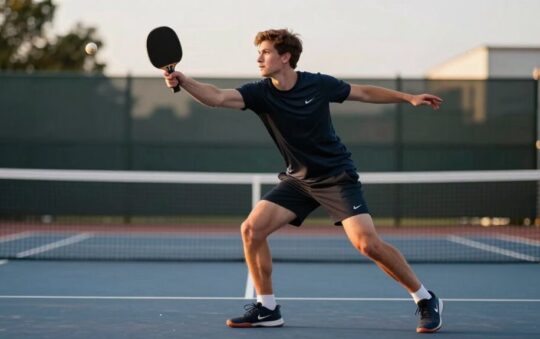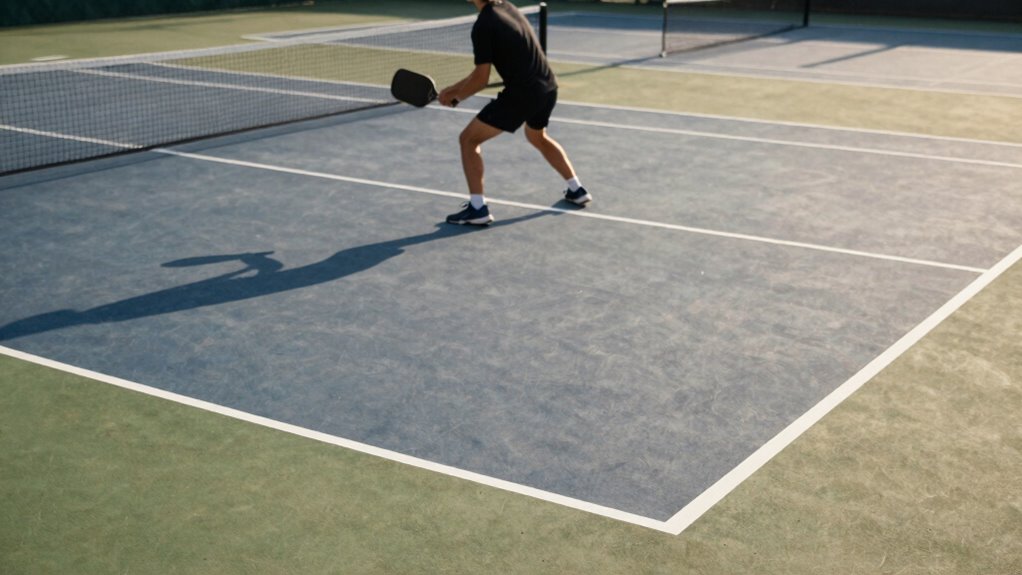
We’ve all stood alone on the court, heart pounding, wondering how to cover 20-by-44 feet of real estate without sacrificing our knees—or our dignity. Serving from behind the baseline, we aim for that diagonal service box, just clearing the 7-foot net—preferably not into the Kitchen. And trust us, learning to pivot between defense and attack? That’s where things get interesting.
Key Takeaways
- Serve underhand from behind the baseline, diagonally into the opponent’s service court, with positioning based on the server’s score (right for even, left for odd).
- Only the server’s score determines serve side, and points are won only by the server through rally play.
- The kitchen (non-volley zone) requires a bounce before volleys; stepping in during a volley results in a fault.
- Use deep serves and returns to control court positioning, then advance to the kitchen line to dominate the net.
- Maintain center-court recovery after each shot and use cross-court dinks to open angles and stretch the opponent.
Key Differences Between Singles and Doubles Pickleball
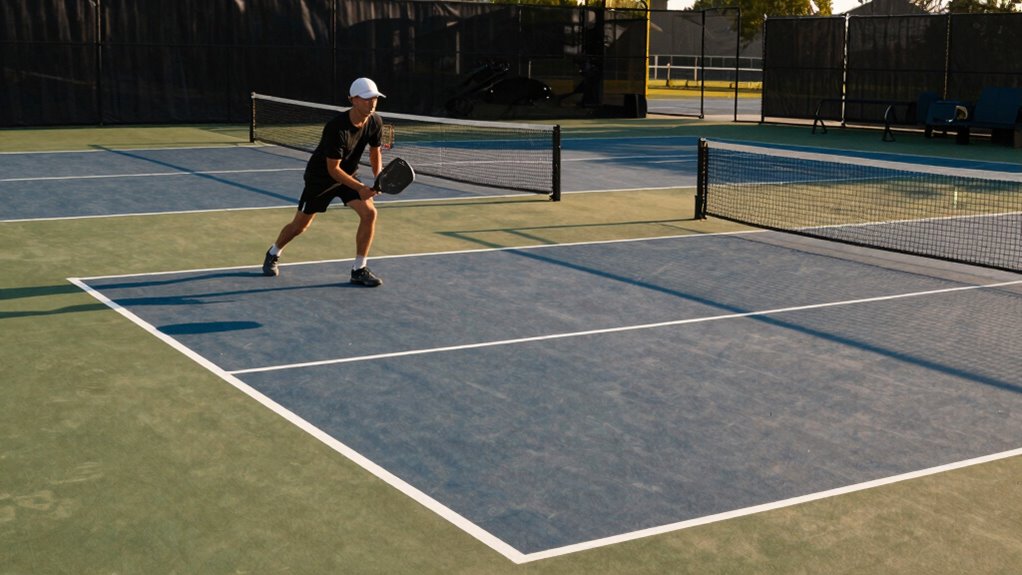
When we step onto the court for singles, we’re immediately reminded there’s no partner to fall back on—just us, 20 feet of net, and the full 20-by-44-foot court we’re required to cover solo.
In singles pickleball, it’s pure self-reliance: every inch of that court is ours to defend, and our legs quickly learn the price of lazy footwork. The serve must be delivered underhand with one hand, and unlike doubles, only one of us serves per side—no first-serve exceptions, no partner to rescue a weak return.
Simpler rules, yes, but heavier demands. We call just two numbers in the score now—ours first, then the receiver’s—cutting chatter and keeping things brisk.
Without a partner, our strategies shift: fewer dinks, more deep baseline drives that push opponents around. We’ve got to master endurance and precision because coverage isn’t shared—it’s wholly on us. Maintaining proper posture alignment during extended rallies prevents strain and keeps us moving efficiently across the court.
We’ve lost points early from overhitting, sure—but now we recognize: in singles, smart placement beats power every time.
Court Dimensions and Layout for Singles Play
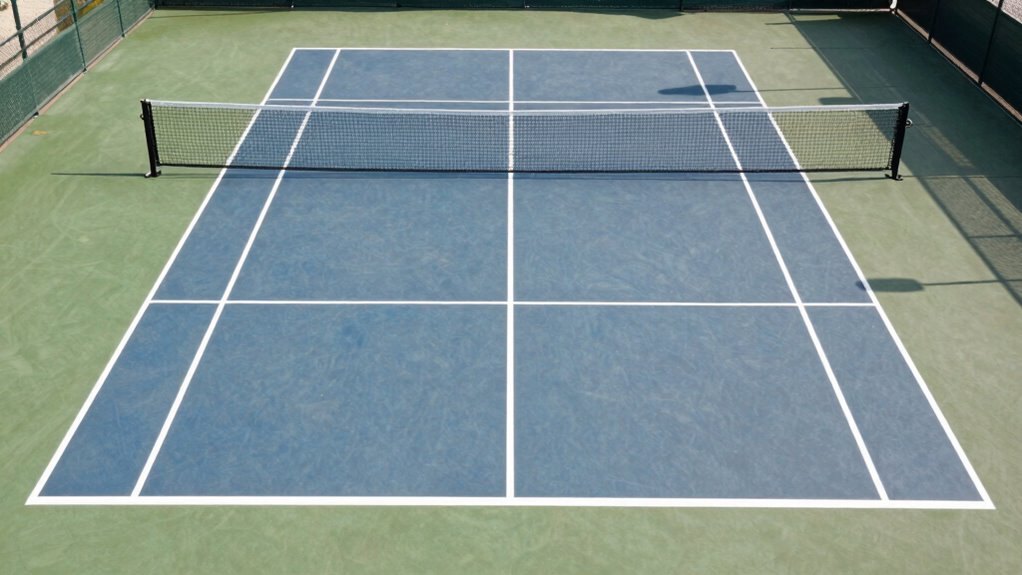
One full court—20 feet wide by 44 feet long—is all we’ve got, and trust us, it feels every inch of it when we’re chasing down a third-deep drive in the third set.
The court dimensions match the standard pickleball court used in doubles—same 20 feet wide, same 44 feet long—but in singles play, we’re alone out there, covering the entire court like runaway linebackers.
No partner to bail us out—just hustle, heart, and a whole lot of side-to-side scrambling. The Kitchen (Non-Volley Zone) still stretches 7 feet from the net, 20 feet wide across, and stepping in while volleying? That’s a fault we’ve all regretted after a particularly bold net rush.
We serve from the right when our score is even, from the left when it’s odd—no exceptions. And yes, we switch sides after winning each point to stay fair with sun and wind.
Staying physically prepared for singles play requires the same dedication to quick fixes and readiness that lightweight, durable gear demands for cycling adventures. It’s chaotic, it’s humbling, and it’s freedom—pure, unscripted movement on a rectangle that suddenly feels enormous.
Serving Rules and Positioning in Singles
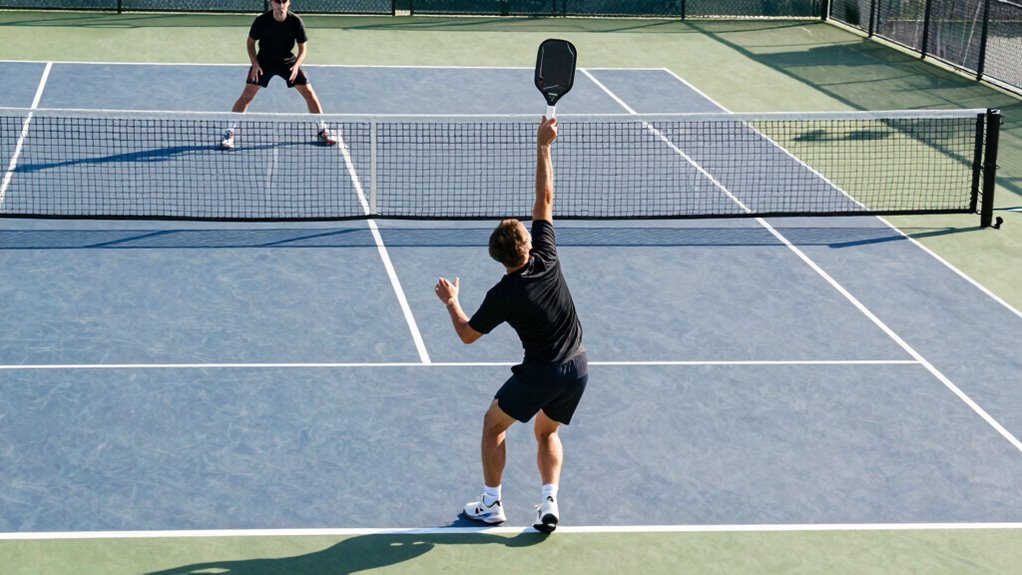
- The server must stand in the correct service box—right side if our score is even, left if the *score is odd*.
- We stay behind the baseline and serve deep into the opponent’s diagonal *correct service box*—no cheating forward, no matter how tempting.
- Only one server per side so when we lose a rally, we just reset—no extra chances.
- We serve deep to avoid the *Kitchen (Non-Volley Zone)* and honor the *Two-Bounce Rule*—both sides let it bounce, no shortcuts.
- Proper court positioning, much like adjustable closures in athletic gear, ensures a secure and controlled stance throughout your serve.
We’ve shanked serves into the *Kitchen* more times than we’d like—lesson learned.
Positioning isn’t restriction; it’s rhythm. Own it, and we own the game.
Understanding the Scoring System in Singles
| Server’s Score | Serve Position |
|---|---|
| Even score | Right side of court |
| Odd score | Left side of court |
We earn every point—one rally at a time. The serve is power and precision. Remember: the player must win by two, or the battle rolls on. We’ve gasped at 14–16 heartbreakers. Stay sharp. Stay free.
Similar to how quick inflation and setup are essential for getting portable paddle boards on the water efficiently, mastering your serve technique and positioning can significantly reduce the time between rallies and keep your momentum flowing throughout the match.
The Two-Bounce Rule and Rally Continuation
Since the serve sets the tone, we always respect the two-bounce rule—it’s non-negotiable, and honestly, it’s saved me from more embarrassing mid-air whiffs than I’d like to admit.
In singles pickleball rules, this means the serve and return must each bounce once before anyone volleys—no exceptions. Once those two bounces drop on the pickleball court, the rally truly begins, and that’s where our freedom to attack or reset opens up.
- The two-bounce rule guarantees fair play and sets the rhythm for every rally.
- We use this pause to reset position—often stepping toward the kitchen line after the return.
- Jumping the gun and volleying early? That’s a fault, and we’ve all lost points that way.
- Smart court strategy starts here: deep returns push opponents back, buying us time.
After the two bounces, we choose—let it bounce again or take the volley? Just as heart rate monitoring helps athletes optimize their performance by tracking physiological responses during intense activity, positioning yourself correctly after the two bounces allows you to monitor your court position and respond strategically to your opponent’s shot placement.
Either way, we own the rally now. This rule isn’t a restraint—it’s our launchpad.
Non-Volley Zone (Kitchen) Rules in Singles
When we charge the net in singles, the kitchen doesn’t just whisper caution—it flat-out shouts it, and more than once I’ve answered back with a volley that cost me the point. The non-volley zone, that 7-foot buffer on either side of the net, demands respect.
In singles, we can’t just smash our way forward—we’ve got to play by the rules and let the ball bounce before hitting from inside the kitchen. Stepping in after a volley? That’s an automatic fault, no debate. We’ve all done it, heart racing, lunging for control, only to gift our opponent the rally.
But smart positioning turns this limitation into power. We use dinks to draw attacks, then slip forward after the bounce, staying outside the line. Just as reinforced ankle support helps basketball players maintain stability during directional changes on concrete, proper footwork and positioning help pickleball players maintain control while navigating the kitchen boundaries. Mastering the dance around the kitchen isn’t just survival—it’s liberation.
It reshapes our court strategy, letting us dictate pace without breaking the rules. The kitchen fences us in, sure—but within its limits, we find precision, patience, and yes, freedom.
Common Faults and How Side-Outs Work
Though we’d like to believe every serve we nail will land deep in the court with laser precision, the truth is we’ve all dumped more than a few into the Kitchen—or worse, sailed them long—handing our opponent the serve on a silver platter.
In the singles game, faults happen fast, and side-outs follow just as quick—each one resetting the score and shifting momentum. Since only the server can score points, keeping our serve clean is non-negotiable.
We’ve learned the hard way that even slight foot faults—like stepping on or over the baseline—cost us dearly. Protecting yourself from injury during intense rallies means considering whether a protective mouthguard would be beneficial for your game. Here’s what we watch for:
- Serves landing short in the Kitchen—they’ll backfire every time
- Foot faults during the serve—stay behind that baseline, no matter what
- Hitting out of bounds—deep corners are great, but not beyond the court
- Poor court coverage after serving—positioning keeps us in control
Mastering these cuts down side-outs, protects our serve, and keeps us dictating the score.
Essential Strategies for Winning Singles Matches
We’ve all had those matches where we keep getting yanked around the court like human windsocks—so let’s fix that with a solid serving strategy.
One deep serve to the “T” pins your opponent back and limits their angles—making it harder to attack. Mix serves to both sides so they can’t predict your next move.
In singles, the return must be deep, too—it buys us time to get to the Kitchen line, where points are won. Use cross-court shots to move your opponent sharply from side to side, opening up that sweet open space behind them.
When they commit forward, drop it short—pull them in, then blast it past. On the pickleball court for singles, covering ground is everything. Like yoga wheels that improve flexibility and balance, strategic court positioning enhances your ability to reach difficult shots and control the net.
We maintain consistent court coverage by always recovering toward the center after each shot. Strategies that make singles win rely on control, not just power—think two steps ahead, dictate the pace, and own every inch of the court.
Win smart. Win free.
Training Drills to Improve Singles Performance
That relentless back-and-forth across the court? We’ve all been there—gasping, missing easy shots, wondering how to improve your singles game.
The truth is, smart training drills make the difference. We’ve tested these, messed up plenty, and finally found what works. Let’s reveal your full potential with focused practice:
- Serve-and-volley drills: Hit a deep serve, then sprint to the Kitchen line—just three steps, but it transforms your aggression and timing.
- Target drills for shot accuracy: Place cones six inches inside each corner—aim within three feet. Miss twice? You’re buying post-game smoothies.
- Rally drills with the two-bounce rule: Have a partner feed you balls that must bounce—teaches patience and cleaner returns.
- Lateral movements and sprints: Zigzag across the baseline to build endurance and boost court coverage.
- Lightweight paddle selection for agility: Consider lightweight paddles under 100g to reduce arm fatigue and enable faster reactions during extended rallies.
We used to collapse by the third game. Now? We’re still moving—light, sharp, and free.
Frequently Asked Questions
What Is the Best Strategy for Singles Pickleball?
we dominate by mastering offensive positioning and serve placement, using smart shot selection and defensive tactics. we control court coverage, analyze our opponent, endure rallies, stay mentally focused, and set the game’s pace to claim our freedom on the pickleball court.
What Are the Official Pickleball Singles Rules?
We follow pickleball scoring, serve rules, fault definition, game format, court dimensions, player positions, equipment requirements, match duration, and rally rules to play freely. We serve underhand, honor two bounces, and claim points only on our serve—liberating play within boundaries built for bold, smart, singles strategy.
How to Play Pickleball Strategically?
We play strategically by mastering court positioning, shot selection, and opponent analysis. Our serve strategies, tactical variations, and shot placement pressure mistakes. We train endurance, sharpen mental toughness, and minimize errors to dominate—with smart, liberated control over every point we own.
Should You Drop in Singles Pickleball?
We drop in because it sharpens our drop shot precision, lets us tweak serve strategy, and hones court positioning. We trade fear for freedom, turning footwork drills, shot selection, and mental toughness into tools of liberation—each rally a step toward mastery, each game pacing decision a breath of control.
Conclusion
We’ve stood in the kitchen—more times than we’d admit—watching our own lobs sail long, the pickleball sunburn on our shoulders proof of hours spent mastering the court. But here’s the truth: every 44-foot sprint, every deep serve aimed just past the baseline, builds something unshakable. It’s not about perfection—our Banger X paddles can’t do magic—it’s consistency. You control the center, own your changes, and suddenly, singles feels less lonely—and a lot more fun.