
Here’s what most people don’t realize: your phone’s battery drains 40% faster in cold temperatures, which means you’re more vulnerable than you think. We’ve all felt that panic when the screen goes black miles from civilization—and honestly, it doesn’t have to end badly. The difference between a minor inconvenience and a real problem comes down to what you pack and how you prepare. Let’s explore the strategies that’ll keep you safe and actually enjoying yourself out there.
Key Takeaways
- Carry a portable power bank with at least 20,000mAh capacity to extend phone battery life during camping trips.
- Use offline maps downloaded via Maps.me or Gaia GPS before departure for navigation without cellular signal.
- Bring traditional navigation tools like physical compasses, topographic maps, and practice triangulation techniques as phone backups.
- Activate Airplane Mode and dim screen brightness to 20-30% to conserve battery and maximize offline map usage.
- Inform someone of your planned route and carry a satellite messenger device for emergency communication when phone dies.
Prepare Before You Leave: Essential Items to Pack
Before you venture into the wilderness where your phone becomes an expensive paperweight, you’ll want to rethink what goes in your pack.
We’ve learned the hard way that ditching cell phone signal means ditching traditional navigation too. Download essential maps beforehand—we use offline apps like Maps.me or Gaia GPS on our devices.
Pack a portable power bank; we’re talking at least 20,000mAh capacity to stretch your battery life across multiple days. Grab a satellite messenger like Garmin’s inReach Mini—it’s genuinely freeing, not terrifying.
Include a physical compass and paper topographic maps as backup. We’ve discovered that this prep work transforms anxiety into confidence.
Consider bringing a solar phone charger as a renewable energy solution for extended trips where traditional power sources are unavailable. You’re not isolated; you’re liberated. This groundwork means you’ll actually enjoy disconnecting rather than panic when that final battery bar disappears.

Once you’ve got your gear sorted and your power bank charged, it’s time to master the tools that won’t quit on you—a map and compass.
We’ve learned the hard way that traditional navigation tools are your real lifeline out there. Start by understanding magnetic declination—the angle between true north and magnetic north—which varies by location.
Practice orienting your topographic map to actual terrain before you leave civilization. Use triangulation by taking bearings from identifiable landmarks, comparing map symbols to what you’re seeing.
Those contour lines? They’re telling you everything about elevation changes ahead.
We can’t stress this enough: practice these skills beforehand. When your phone dies at mile seven, you’ll thank yourself. Before heading out, ensure you have a well-equipped first aid kit in your pack to handle any injuries that may occur when you’re navigating without digital assistance.
Stay Safe When Communication Fails: Emergency Protocols
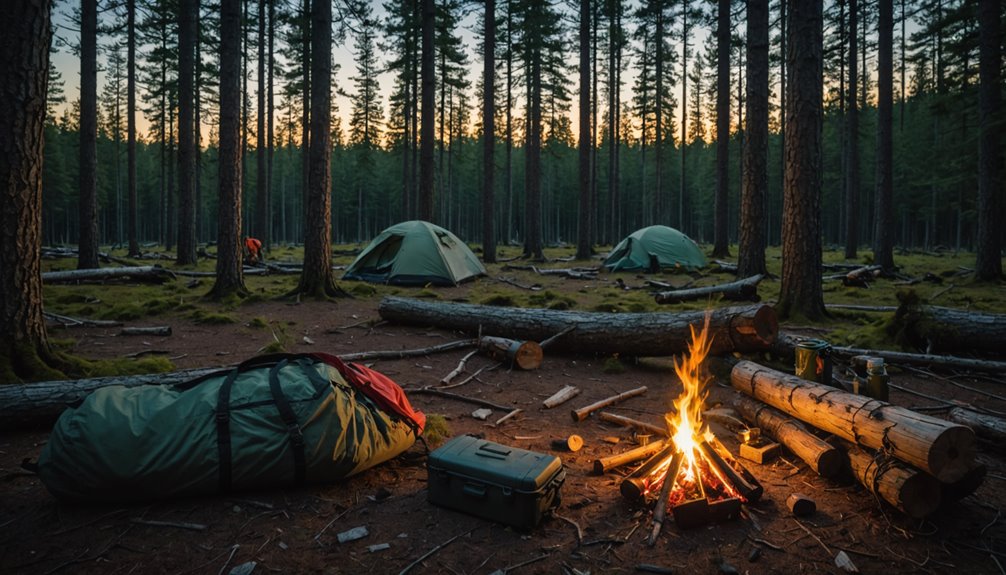
When your battery dies and the forest goes quiet, that’s when your preparation becomes your lifeline. We’ve learned that relying solely on cell signal is risky—even dangerous.
Here’s what we recommend:
- Tell someone your route and return time before leaving civilization
- Carry a satellite messenger device like a Garmin InReach for true backcountry freedom
- Locate ranger stations on your map before you venture out
- Stay visible on well-traveled paths where other hikers can spot you
- Pre-plan your response to emergencies so panic doesn’t cloud judgment
An emergency plan isn’t paranoia—it’s freedom. When you’ve thought through scenarios beforehand, you’re not scrambling in crisis mode.
We’ve found that a dedicated communication device transforms backcountry trips from nerve-wracking to genuinely liberating. You’re connected to safety without needing cell towers. That’s real independence.
Extend Your Phone’s Battery Life: Practical Strategies
Your phone’s battery drains fastest when it’s hunting for signal that doesn’t exist—we’ve watched our devices die in half the time out here, desperately pinging towers miles away.
Here’s what actually works: flip Airplane Mode on immediately. You’ll still access offline maps and use your flashlight without that constant energy drain. Dim your screen to 20-30% brightness; it’s genuinely readable outdoors.
Close background apps ruthlessly—they’re silent battery vampires. Consider these moves essential: limit calls to emergencies, disable location services, and kill push notifications.
We’re not suggesting you ditch technology entirely. Instead, bring a portable charger—a solid power bank weighs barely more than snacks. Lightweight power stations offer even greater capacity for extended trips, with many weighing under 10 pounds while providing enough energy to charge your phone multiple times over.
These battery life extensions transform your phone from liability into genuine tool. Out here, smart energy management means genuine freedom.
Make the Most of Your Offline Experience: Alternative Activities
So you’ve squeezed every last percent from your battery and silenced the constant signal-hunting drain—now what?
We’ve discovered that freedom from our phones opens up genuine connection with the wilderness.
Here’s what we’ve found transforms dead-phone anxiety into genuine joy:
- Read downloaded books or maps—knowledge and entertainment without dependency
- Try campfire cooking experiments—turning meals into creative adventures
- Explore your surroundings through hiking—reconnect with nature’s raw beauty
- Journal or sketch your experiences—reflection becomes documentation becomes art
- Play cards or clean gear—productivity meets entertainment seamlessly
Proper gear selection like lightweight cooking sets ensures your offline meals are prepared efficiently without requiring constant device assistance.
These offline activities aren’t consolation prizes.
We’ve learned they’re gateways to the liberation we actually sought.
When we capture your experiences without screens mediating everything, something shifts.
The wilderness becomes less backdrop and more conversation partner.
That’s the real signal worth finding.
Frequently Asked Questions
How to Get Phone Signal While Camping?
We’ve found that moving to higher ground works best for catching signal. We’re also recommending phone boosters and signal apps as essential camping gear. They’ll help you break free from connectivity dead zones so you’re never truly disconnected from what matters.
How to Save Phone Battery When Camping?
We’ll keep your phone alive while ditching civilization’s chains. Activate airplane mode, dim that screen, and ditch background apps. We’re talking essential battery saving tips, camping gadgets like power banks—freedom’s fuel. You’ve got this.
How to Get a Phone Signal in a Dead Zone?
We can escape dead zones by climbing higher ground, toggling airplane mode, or using signal boosters. We’ll download emergency apps and offline maps beforehand—freeing ourselves from grid dependency and reclaiming true wilderness independence on our own terms.
Does Putting My Phone in Rice Really Work?
We’ve all heard the myth—but here’s the truth: rice isn’t our best ally for water damage prevention. We’d rather embrace silica gel or air-drying for genuine phone drying methods. Skip the rice trap; we’ll choose emergency charging solutions and proven alternatives that don’t compromise our device’s freedom.
Conclusion
We’ve covered the essentials—offline maps, battery packs, compasses, and emergency protocols—but here’s the real question: isn’t the best preparation simply accepting that disconnection’s actually liberating? We’ve discovered that camping without our phones doesn’t diminish safety; it enhances it. You’ll navigate better, communicate clearer through planning, and genuinely experience nature. Pack smart, tell someone your route, and embrace the silence. Your next adventure starts now.