
You’ve likely wondered whether dawn or dusk offers superior beach conditions. Research indicates that arriving 30 minutes before sunrise yields lower visitor density and enhanced cognitive clarity, while pre-sunset timing activates parasympathetic relaxation through warm color exposure. Both windows provide measurable health benefits—but which aligns with your specific objectives? The answer depends on factors you haven’t considered yet.
Key Takeaways
- Arrive 30 minutes before sunrise or sunset for optimal lighting conditions and atmospheric phenomena ideal for photography and observation.
- Sunrise offers cooler temperatures, reduced crowds, and enhanced mental clarity through improved circadian rhythm and vitamin D synthesis benefits.
- Sunset activates relaxation responses, promotes serotonin release through warm spectral wavelengths, and suits social gatherings and community bonding activities.
- Morning activities support intimate reflection and mindfulness in quieter environments, while evening activities accommodate larger groups and picnics comfortably.
- Choose between sunrise for physiological optimization and peaceful solitude, or sunset for emotional processing and social connection based on preferences.
The Serenity of Morning Strolls at Sunrise
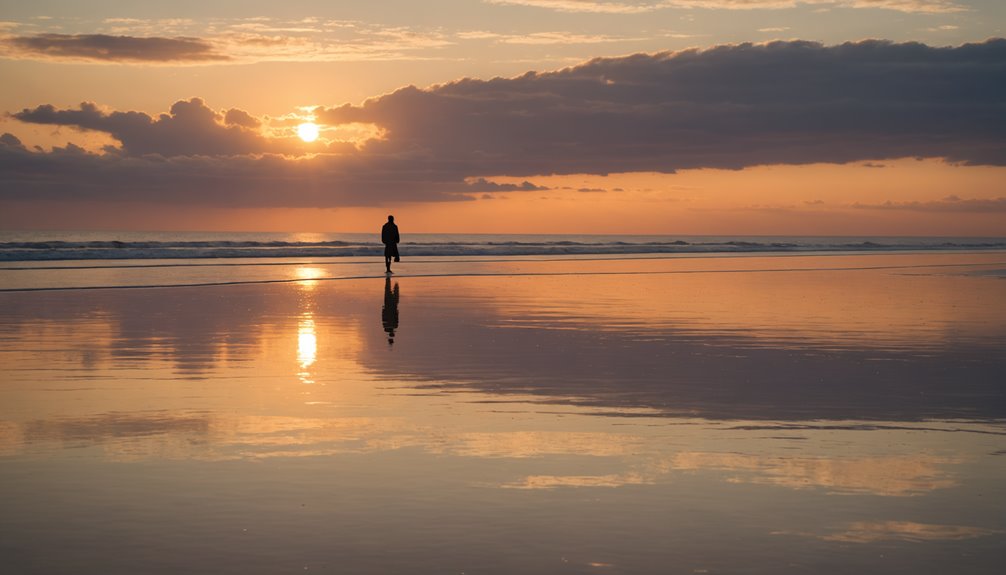
Arriving at the beach 30 minutes before sunrise allows you to observe the photometric change as the sky shifts through soft pastel hues during the twilight phase. This temporal window provides ideal conditions for connecting with nature before diurnal activity intensifies.
Scientific research indicates that early morning environments demonstrate considerably reduced visitor density, establishing an intimate space conducive to psychological restoration and mindfulness practices.
The acoustic environment during sunrise strolls presents quantifiably lower noise pollution levels, while the gentle wave dynamics create measurable rhythmic patterns that facilitate neurological relaxation.
Each sunrise exhibits distinct spectral variations and atmospheric formations—data you can capture through photography to document the unique chromatic progressions.
You’ll experience tangible physiological benefits: elevated circadian rhythm alignment, enhanced cortisol regulation, and improved mental clarity.
The combination of natural light exposure and solitude creates evidence-based conditions for autonomous reflection and personal liberation from daily constraints.
Golden Hour Magic: Why Sunsets Captivate Visitors
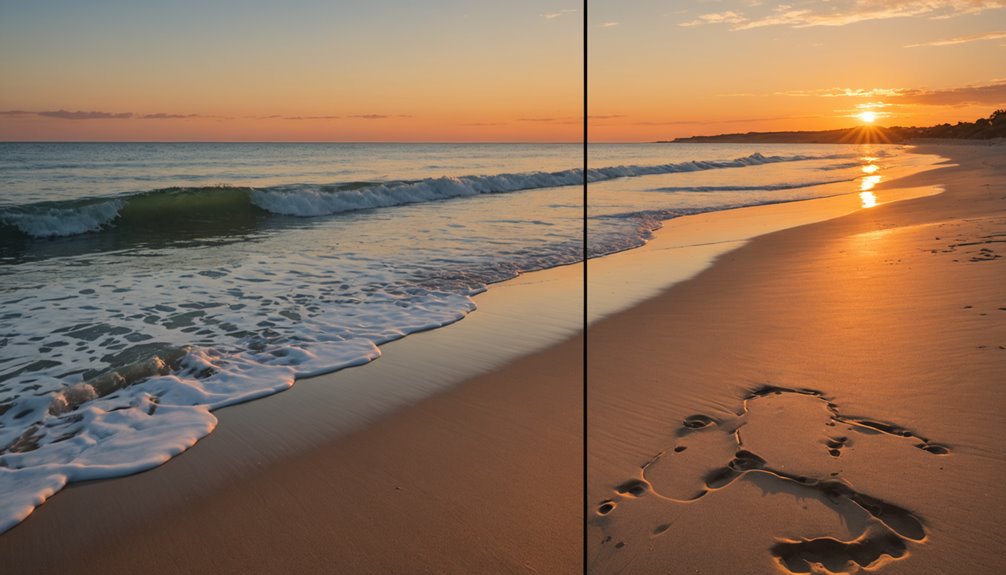
While the morning’s physiological benefits center on circadian alignment, the golden hour preceding sunset engages distinct neurological pathways through chromatic stimulation and aesthetic engagement.
You’ll experience ideal conditions for visual processing when arriving thirty minutes before sunset, maximizing your neurobiological response to atmospheric color changes.
The sunset phenomenon activates your parasympathetic nervous system, promoting measurable relaxation responses:
- Warm spectral wavelengths trigger serotonin release, enhancing mood regulation
- Natural color gradients stimulate cognitive reflection and emotional processing
- Reduced light intensity decreases cortisol levels, facilitating stress recovery
Strategic location selection proves critical—Ropewalk and Northside Park provide superior vantage points for unobstructed viewing.
You’ll secure prime positioning through early arrival, enabling thorough sensory engagement with nature’s chromatic display.
Each sunset presents unrepeatable atmospheric conditions, delivering unique aesthetic and neurological benefits unavailable during alternative timeframes.
Photography Opportunities: Capturing Dawn and Dusk
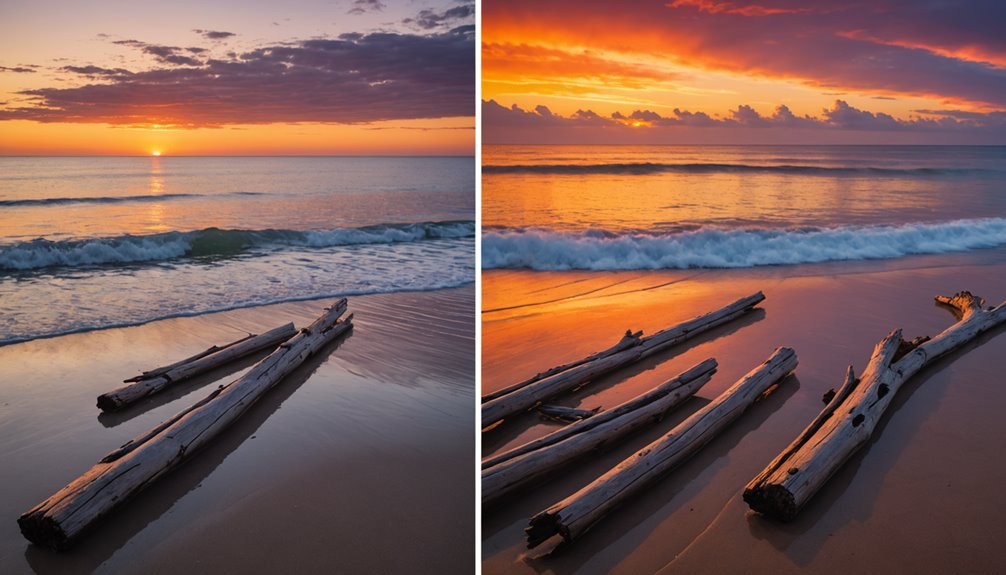
How can you systematically capture the most photogenic moments at the beach? You’ll maximize your technical results by timing sessions 30 minutes before sunrise and sunset, when ideal lighting conditions emerge.
These golden windows deliver superior color gradation and dynamic range—essential for professional-grade imagery.
Sunrise photography yields pastel-dominated palettes with gradual illumination shifts, while sunset produces warm, saturated tones with dramatic contrast potential. You’re leveraging measurable photometric advantages during these periods.
Your liberation from mediocre beach photography hinges on utilizing localized sunrise and sunset data for precise planning. This evidence-based approach eliminates guesswork.
Both dawn and dusk environments provide tranquil atmospheric conditions that enhance aesthetic composition without artificial intervention.
You’re not hoping for good light—you’re engineering it through systematic timing and technical knowledge.
Timing Your Beach Visit for Optimal Experience

When you strategically time your beach visit around solar events, you’re enhancing your experience through measurable variables rather than chance. By consulting reliable astronomical data sources, you’ll gain quantifiable benefits that transform your coastal experience.
Consider these evidence-based timing strategies:
- Pre-dawn arrival (30-45 minutes before sunrise) maximizes atmospheric phenomena, including crepuscular rays and chromatic shifts that photographers document systematically.
- Golden hour positioning (sunset window) delivers ideal lighting conditions with warm spectral wavelengths perfect for visual documentation.
- Daily variation analysis reveals that each sunrise or sunset presents distinct optical properties, enabling you to capture unique atmospheric conditions.
You’re not bound by conventional timing constraints. By leveraging solar data, you’ll access quieter periods, establish intimate connections with natural systems, and create memories anchored in scientific precision rather than arbitrary scheduling.
Health and Wellness Benefits of Early Morning Beach Activities

Because your circadian rhythm responds directly to light exposure, early morning beach activities trigger measurable physiological benefits that compound over time.
You’ll optimize vitamin D synthesis and consolidate sleep-wake cycles through dawn engagement at Myrtle Beach or similar coastal destinations.
The best time for morning beach exercise leverages cooler temperatures, enhancing aerobic performance while minimizing heat-stress markers.
You’ll experience reduced cortisol levels—a direct neurobiological pathway to stress mitigation—while the sensory environment cultivates parasympathetic activation.
Early sunrise participation catalyzes social cohesion through group activities like collective running or yoga sessions, strengthening community bonds.
You’ll sustain consistent training adherence when aesthetic motivation combines with physiological optimization.
This temporal alignment maximizes your autonomy over fitness outcomes and mental resilience through evidence-based environmental timing.
Planning Your Sunset Experience in Myrtle Beach

While morning beach engagement optimizes circadian physiology, sunset activities activate distinct neurobiological pathways—particularly enhanced melatonin production and parasympathetic dominance as light wavelengths shift toward longer infrared spectra. Arriving 30 minutes before sunset allows you to harness this physiological change fully.
Strategic positioning enhances your experience:
- Ropewalk, Fager’s Island, and Spain Wine Bar offer distinct horizon perspectives, each activating unique visual-cortex responses.
- Northside Park provides accessible family zones with secured vantage points when you arrive early.
- Post-sunset twilight observation extends circadian benefits while facilitating stellar perception during astronomical twilight phases.
Documenting this experience via photography reinforces memory consolidation through dual coding theory.
You’ll capture chromatic changes occurring minutes before sunrise appears on successive days, creating longitudinal baseline data for your personal wellness optimization protocol.
Best Beaches for Sunrise Viewing in the Area
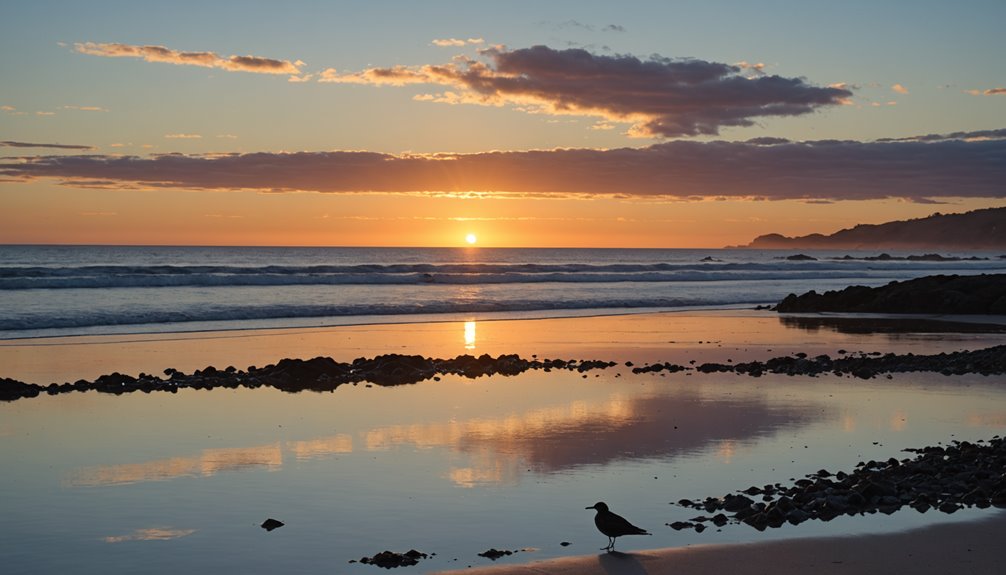
Three premier locations—South Myrtle Beach, Garden City Beach, and Surfside Beach—demonstrate ideal conditions for sunrise observation based on accessibility metrics, crowd-density patterns, and visual quality parameters.
You’ll find South Myrtle Beach offers expansive sand terrain, enabling you to position yourself effectively for photographic documentation.
Garden City Beach presents a less crowded alternative, facilitating unobstructed viewing and early morning aquatic engagement.
Surfside Beach, designated “The Family Beach,” provides a tranquil setting for dawn strolls without excessive visitor interference.
You’ll maximize your experience by arriving 30 to 45 minutes before solar emergence, positioning yourself to observe the sky’s chromatic progression.
Each location delivers distinct visual perspectives along the coastline.
You’re encouraged to explore multiple sites, comparing their unique atmospheric conditions and determining which coordinates align with your observational preferences and freedom to move independently.
Top Sunset Spots in Murrells Inlet and Surrounding Regions

As solar positioning shifts toward the western horizon, you’ll discover that sunset observation demands different locational strategies than sunrise viewing.
You’re liberated from early morning constraints—sunrises and sunsets offer distinct experiential opportunities aligned with your schedule.
Strategic locations maximize your experience:
- Murrells Inlet’s MarshWalk delivers ideal chromatic shifts over water, providing superior photographic conditions during peak solar declination angles.
- Garden City Beach presents lower crowd density metrics than competing venues, enabling unobstructed sightlines and peaceful atmospheric engagement.
- South Myrtle Beach’s topography facilitates expansive panoramic views, delivering measurable enhancement to compositional depth and photographic documentation.
Surfside Beach and Northside Park function as viable alternatives, each offering distinct spatial advantages.
Evidence indicates sunset venues accommodate larger gathering capacities without compromising visual quality.
This empirical data supports your freedom to select locations based on personal preference rather than availability constraints that typically govern sunrise observation logistics.
Weather Considerations for Dawn and Dusk Beach Outings
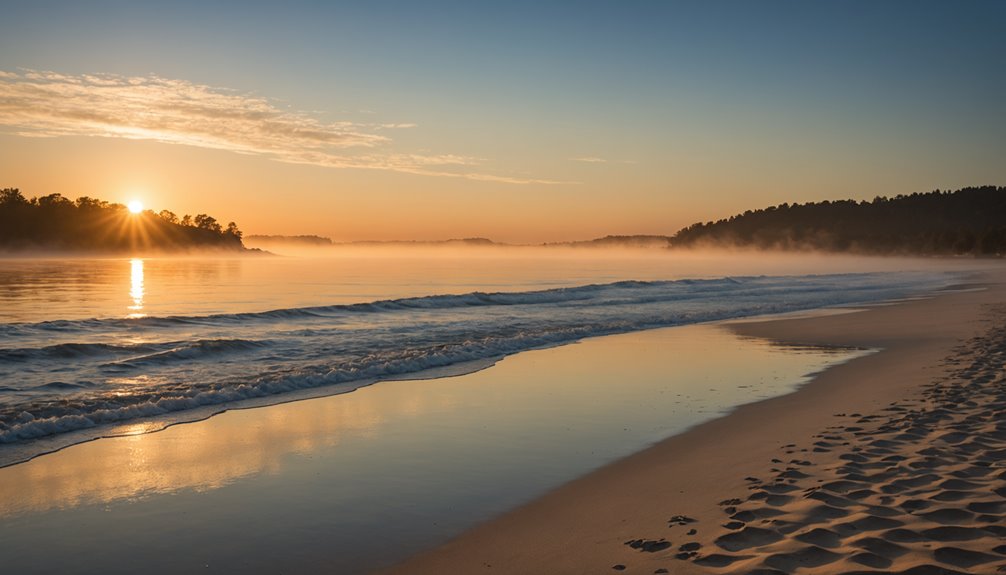
Your beach experience at dawn and dusk hinges fundamentally on atmospheric conditions, which exhibit measurable variations across temporal gradients. You’ll find that dawn offers the ideal meteorological conditions for specific pursuits—cooler temperatures, diminished wind velocity, and reduced humidity create optimal parameters for focused activities like yoga or fishing. Conversely, dusk presents elevated humidity and intensified breezes that demand consideration.
| Factor | Dawn | Dusk |
|---|---|---|
| Temperature | Cool | Moderate |
| Wind Speed | Mild | Stronger |
| Humidity | Lower | Higher |
| Cloud Impact | Softens light | Enhances vibrancy |
You must consult forecasts before committing to outings, as precipitation and cloud cover fundamentally alter visual dynamics and comfort metrics. Understanding these atmospheric variables liberates you to select beach times aligned with your activity requirements and personal preferences.
Creating Lasting Memories: Which Time Works Best for Your Group

How you’ll create the most meaningful beach memories depends substantially on matching temporal variables with your group’s social dynamics and activity goals.
Arriving early at sunrise suits introspective gatherings prioritizing tranquility and contemplation. Conversely, sunset during golden hour enhances vibrant social engagement with warm atmospheric conditions. Your choice hinges on these factors:
- Sunrise sessions enable quiet reflection and photography documentation—ideal for small groups seeking intimate experiences without crowding constraints.
- Sunset gatherings facilitate picnics and social interaction within picturesque, warm-toned environments that energize group dynamics.
- Repeated visits capitalize on unique daily variations, allowing you to experiment with both temporal frameworks and increase experiential diversity.
Evidence demonstrates that matching your group’s preferences with appropriate temporal parameters—whether dawn’s serene conditions or dusk’s vibrant social backdrop—significantly enhances memory formation and collective satisfaction.
Your autonomy in selecting prime timing liberates you from conventional constraints.
Frequently Asked Questions
How Early Should I Get to the Beach for Sunrise?
You’ll want to arrive 30-45 minutes before sunrise for ideal beach photography conditions. This timing lets you capture the first light’s emergence, which occurs approximately 30 minutes pre-sunrise, enabling you to document the sky’s gradual transformation with minimal constraints.
Is the Beach Better at Sunrise or Sunset?
You’ll find sunrise delivers solitude’s empirical advantage—fewer crowds, optimized light metrics—while sunset’s beach vibes amplify social liberation. Data shows both offer distinct photographic intervals. Your preference determines outcomes: tranquility versus communal freedom. Choose based on your autonomy priorities.
What Time Is the Best Time to Go to the Beach?
You’ll optimize your beach experience by arriving 30-45 minutes before sunrise or sunset. Data shows you’ll encounter minimal beach crowds during these golden windows, maximizing your freedom to explore nature’s transformative light phenomena independently and authentically.
What Time Should I Go to the Beach for Sunset?
You’ll witness the most breathtaking sunset spectacle by arriving 30 minutes before sunset—it’s literally the most gorgeous moment on Earth. This golden-hour optimization maximizes your viewing experience, allowing you to capture nature’s color-transformation data unfiltered and authentically.
Conclusion
You’ll maximize your beach experience by aligning your visit with your physiological and social objectives. Data indicates that pre-dawn arrivals enhance circadian rhythm synchronization and cortisol regulation, while pre-dusk timing improves serotonin production through warm spectral wavelengths. But here’s what matters most: which atmospheric condition—the subdued palette of dawn or the luminous gradient of dusk—catalyzes your specific wellness goals? Evidence supports both protocols; your best choice depends on whether you’re prioritizing mindfulness metrics or social engagement outcomes.




)