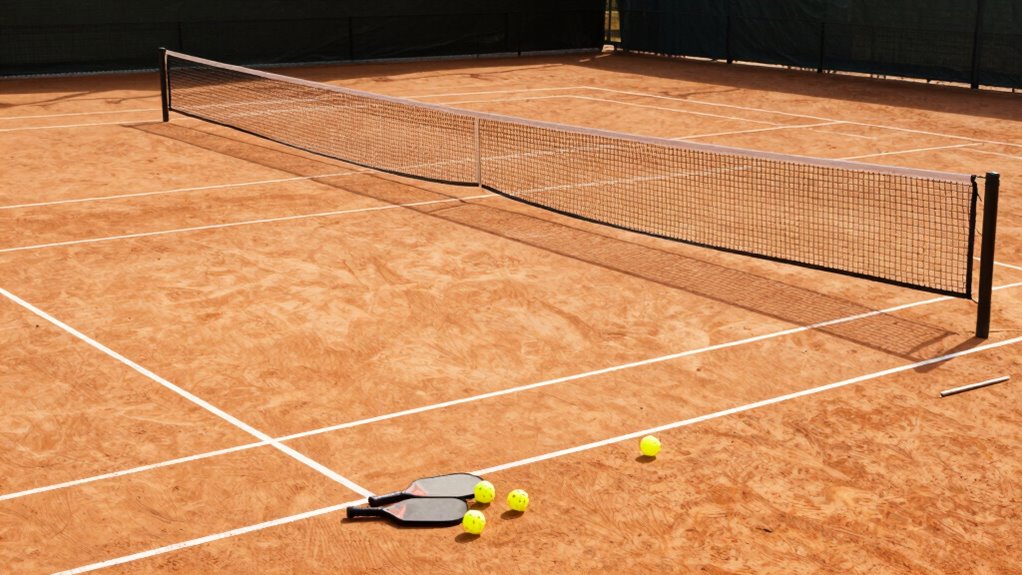
We’ve squeezed pickleball onto tennis courts more times than we care to admit — usually with duct tape, a measuring tape, and hopeful grins. The good news? Our courts fit four pickleball courts within one tennis rectangle — 78 by 36 feet — no demolition required. We drop the net to 34 inches at the center (or haul out our portable Rally Roll) and use bright neon tape for lines — 20 by 44 feet with 2-inch widths, just like official specs. And yeah, we still step on the lines. Every. Single. Time. But here’s what most newcomers miss —
Key Takeaways
- Convert a tennis court by marking a 20 by 44-foot pickleball court within its dimensions using tape.
- Adjust the net height to 36 inches at the sides and 34 inches at the center for proper play.
- Use portable nets if the tennis net can’t be lowered to pickleball specifications.
- Clearly mark 2-inch-wide boundary lines with bright tape to avoid confusion during gameplay.
- Communicate with other players to schedule shared use and maintain respectful court etiquette.
Understanding the Key Differences Between Pickleball and Tennis Courts
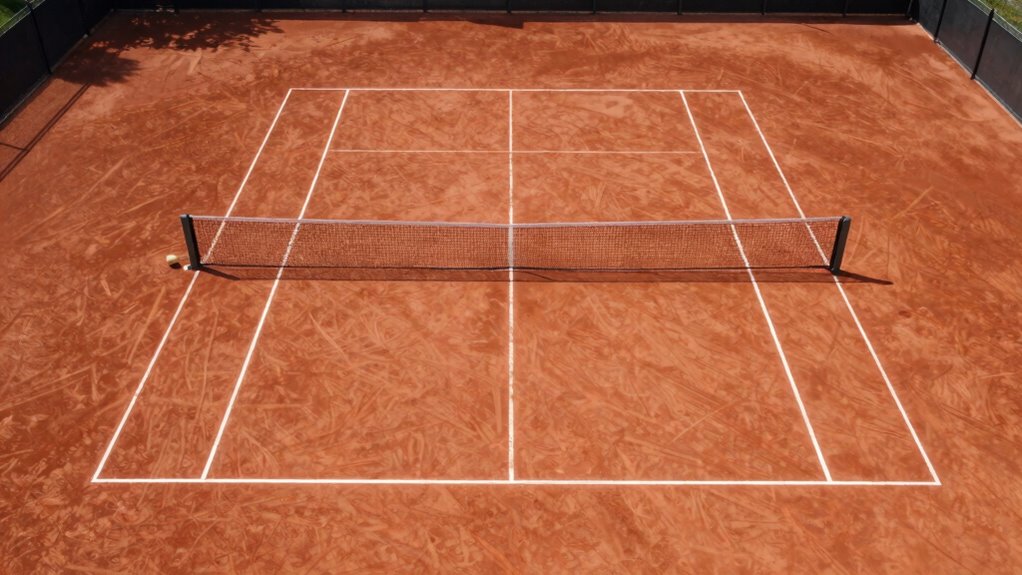
While we didn’t expect to fit four pickleball courts on a single tennis court the first time we tried, we were surprised—measuring out the 20-by-44-foot pickleball dimensions right over the tennis lines, we realized how much game they actually share. The court dimensions are smaller, sure, but that tight space sharpens our focus—no lazy retrieves here.
We’ve marked pickleball lines with tape over the tennis baseline, and though the net height differs (36″ at the sides, 34″ in the center), we’ve adjusted old tennis nets or used temporary pickleball ones. Surface compatibility? We’ve played on cracked hard courts and dusty clay without issue—tennis and pickleball thrive on the same existing sports infrastructure. Like a well-designed home gym setup, converting a tennis court maximizes existing resources for multiple purposes.
Converting a tennis court isn’t just smart—it’s liberation. We reclaim empty courts, transform them through court conversion, and honor proper pickleball etiquette even in makeshift setups.
Sure, tennis lacks “The Kitchen,” but we respect it anyway—it’s where rallies live and egos die. This isn’t just crossover play; it’s community reborn from what we already have.
How to Set Up a Pickleball Net on a Tennis Court
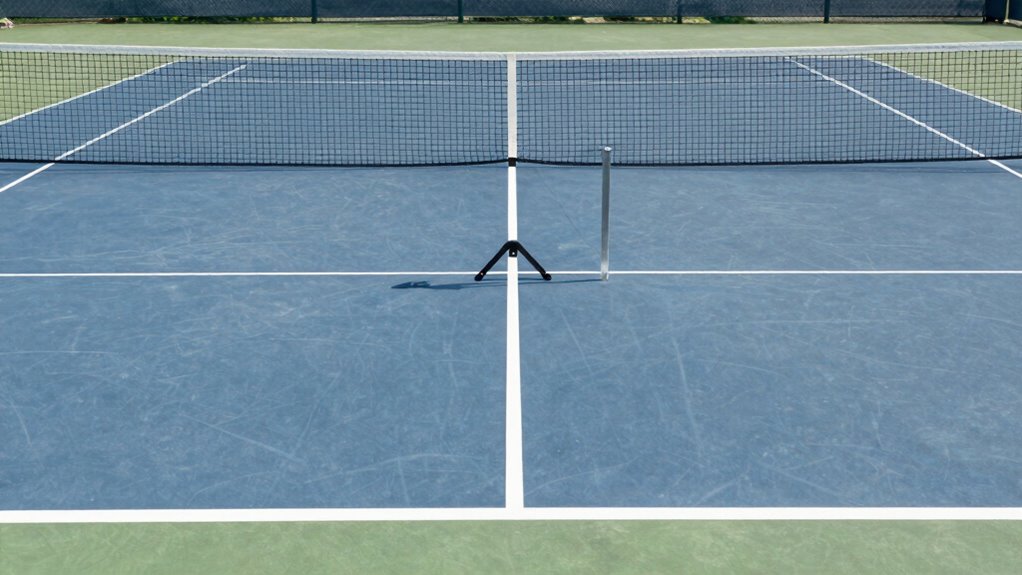
We’ve lowered more tennis nets than we care to count—usually crouching with a wrench in hand, grumbling about rusted cranks—just to get the height right for pickleball. When using a tennis court, we always check if the existing tennis net adjusts: it must drop to 36 inches at the sidelines and 34 in the center. If it won’t budge, we ditch the struggle and switch to a portable pickleball net—22 feet wide, just like official dimensions require.
Before we set up a pickleball net, we measure a 20 by 44-foot rectangle to map the court boundaries, aligning it inside the tennis court’s width. Accuracy matters—wrong placement cramps the kitchen area and throws off gameplay. We double-check our measurements, because trust us, arguing over net height mid-game kills the vibe. Proper setup techniques enhance the court’s functionality, much like how reinforced construction ensures durability in sports equipment.
A portable pickleball net saves time and hassle, giving us freedom to play anywhere. With the net right and court boundaries clear, we’re ready—no permits, no permission, just pure, unfiltered play.
Marking Pickleball Court Lines on a Tennis Surface
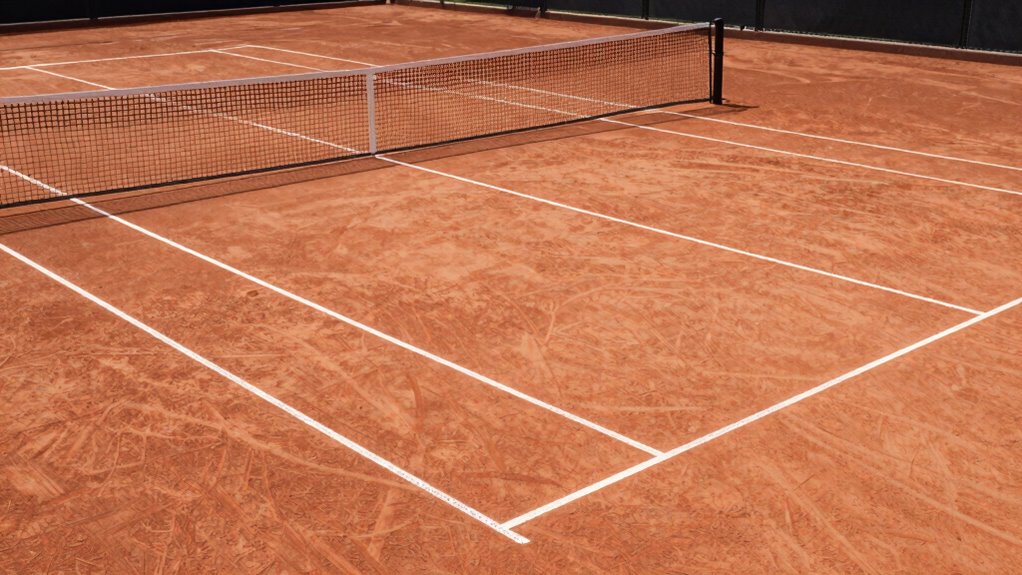
Since we’re already standing on a tennis court with the net set at 34 inches, it’s time to tackle the real puzzle—painting the pickleball lines without turning the court into a geometry exam.
When converting a tennis court for pickleball, accuracy frees us, so we grab our measuring tape and start mapping the 20-by-44-foot pickleball dimensions. We mark sidelines and baselines first, then lay out the 7-foot no-volley zone—because nobody wants an accidental fault.
We use temporary markers like bright tape; they’re cheap, visible, and won’t trap us with permanent paint. Remember, pickleball lines must be exactly 2 inches wide—tape works perfectly here. Proper fit and accurate spacing ensure the court meets official regulations just like quality riding gloves require precise measurements for optimal performance.
We double-check measurements before finalizing—once, then again—because even a small error warps the whole layout. We align court boundaries so they’re square and tight, making sure everything mirrors the official specs.
And yes—we’ve messed this up before, ending up with a crooked kitchen that confused everyone. But now? We’ve got it down.
With the correct height set and lines clearly marked, we’re ready to play free, fair, and fast.
Adjusting Your Game Strategy for a Larger Court
When we first played pickleball on a tennis court, we sprinted like headless chickens—arms flailing, shots falling short—because we forgot the court was nearly twice as long as a regulation pickleball court.
Playing pickleball on tennis means adjusting your game strategy from the start. The larger space of tennis courts for pickleball—78 feet by 27 feet—changes everything, from serve techniques to how we cover court surfaces.
Here’s how we’ve learned to adapt as players:
- Use strategic shot placement to stretch opponents and open up angles.
- Rethink serve techniques—add more power or spin to clear the extra 10 feet.
- Hang back and use the baseline effectively; it’s our anchor on bigger court surfaces.
- Mix in lobs and drop shots to keep rivals guessing and off balance.
- Move smarter, not harder—conserving energy during long rallies on a tennis court.
- Consider how breathable materials in your athletic wear can help manage sweat and comfort during extended play on larger courts.
Pickleball on a tennis court rewards patience, precision, and creativity—we’ve turned chaos into control.
While we can’t claim we’ve mastered the art of court sharing overnight—our early attempts included yelling “Out!” during a tennis rally only to realize we’d called their ball, not ours—we now know that clear communication keeps peace on shared tennis courts turned pickleball zones.
When we play pickleball on a tennis court, we’re borrowing space, not claiming it. We mark our court lines with bright tape or chalk so boundaries stay clear—no fuzzy guessing near the non-volley zone, which spans 7 feet from the net on both sides. Respecting that zone keeps gameplay etiquette honest.
We’ve learned to stash our gear, step aside during tennis points, and wave thanks—small acts of sportsmanship that build trust. Scheduling conflicts? We chat early, rotate access, and text to confirm. Shared space thrives on respect, not rules. Just as portable goals require weather-resistant materials to endure outdoor conditions, shared court spaces need proper maintenance and care to remain safe and functional for all players.
And humor helps—like the time we accidentally bounced a pickleball into a tennis serve and apologized with granola bars. Good communication, visible lines, and mutual care let both games coexist. We’re not just sharing a court—we’re building a community.
Frequently Asked Questions
Can I Play Pickleball in a Tennis Court?
We can play pickleball on a tennis court—yes! We adapt court markings, adjust net height, respect pickleball rules, and share the playing surface. We redefine game strategy, embrace social aspects, and liberate fun from traditional equipment differences and scoring systems, all within tennis court dimensions.
How to Play Pickleball Using a Tennis Court?
we convert tennis courts by marking proper court dimensions, use portable nets for correct height, follow pickleball rules, adapt serving techniques, and embrace fun variations while respecting court etiquette—liberating our game with creative, fast-paced play.
Can You Have a Pickleball Court on a Tennis Court?
Yes, we’ve turned single tennis courts into pickleball havens—four courts bursting with life! Our vibrant community thrives using tape for pickleball dimensions, adjusting net height, and tackling scheduling conflicts with creative court conversion—freedom on every playing surface.
Is Pickleball Allowed on a Tennis Court?
yes, we can play pickleball on a tennis court—pickleball regulations allow it, and surface compatibility makes it easy. we embrace the sport’s popularity, game rules, and recreational opportunities without sacrificing player etiquette or community involvement in facility management.
Conclusion
We’ve turned tennis courts into pickleball havens more times than we can count—sometimes with duct tape and hope. At 20 by 44 feet, the lines fit like puzzle pieces on the bigger slab. We level up our game by adjusting serves—and our egos—when the space fools us. Shared courts mean shared laughs, especially when someone wanders into “our” zone. Just mark it, claim it, and play on.