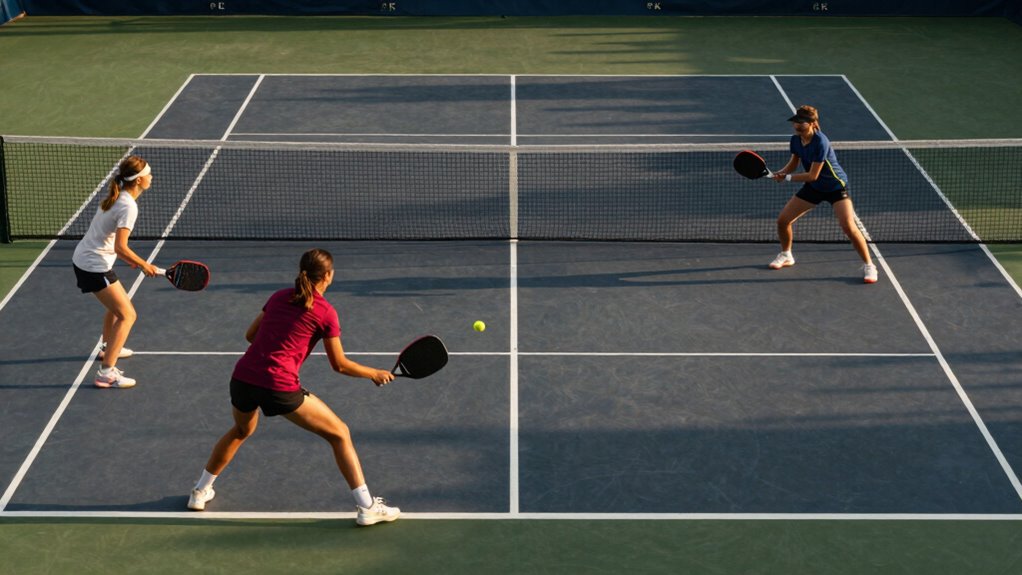
Is it really true that most doubles points are won or lost before the third shot? We’ve stood on courts from local rec centers to regional tournaments—often in Asics no-shows with sweat-stained Gamma paddles—and learned the hard way: positioning beats power. One misstep in the 7-foot NVZ, one lazy serve return, and suddenly you’re chasing dinks like it’s a comedy sketch. Let’s fix that.
Key Takeaways
- The serving team must follow underhand serve rules and serve from the correct side based on the score’s parity.
- Both teams must allow one bounce per side before volleying, known as the double bounce rule.
- Players cannot volley while in the non-volley zone or touching its lines to avoid faults.
- Only the serving team can score points, with two servers rotating until a fault ends their turn.
- Clear communication and coordinated positioning between partners prevent overlap and improve court coverage.
Court Positioning and Strategic Fundamentals
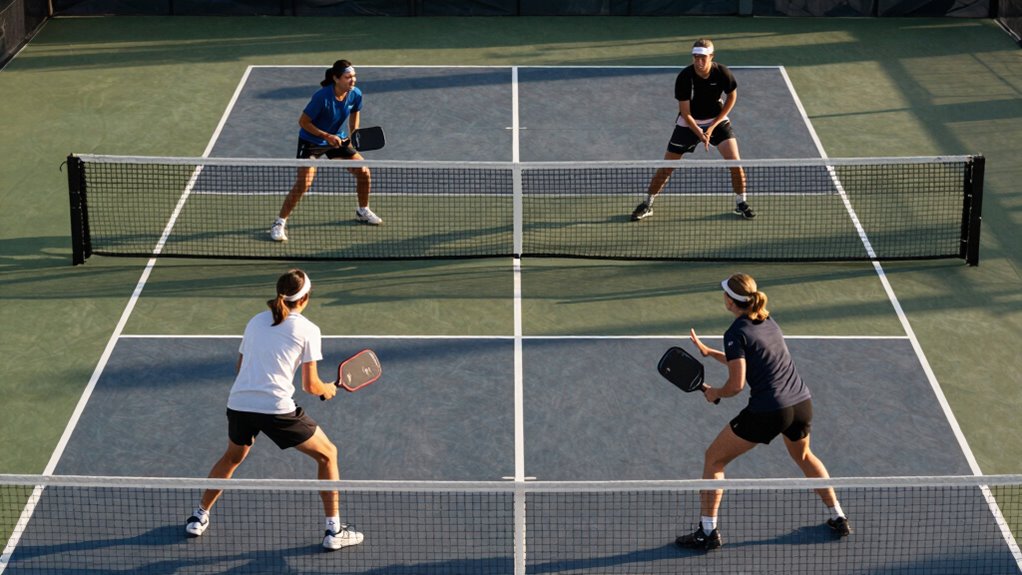
When we step onto the court, we’re not just playing a game— we’re solving a real-time puzzle of space, timing, and partnership, and the first piece? Court positioning.
In doubles pickleball, strategic positioning isn’t optional— it’s survival. We’ve learned the hard way: if we don’t move as one, we’re toast. The serving team starts behind the baseline—20 feet wide, 44 feet long, no shortcuts. Players must respect the double bounce rule, giving the rally room to breathe before advancing.
Once that’s done, we charge the kitchen line together—no straggling. That net zone is where we build our effective defense and control the pace. We stack positions when needed—yeah, our lefty partner hates the right side, so we swap—keeping stronger shots ready. Just as proper fit and adjustable closures ensure comfort and control in athletic performance, our court positioning requires the same attention to detail and synchronization.
It’s not about rigid rules; it’s fluid, alive. Team scores climb when we’re synced, not just strong. The scoring system in doubles rewards unity, not ego. We’ve dumped the old “one dominant player” act—liberation lives in balance, not brute force.
Serving Rules and Scoring for Doubles
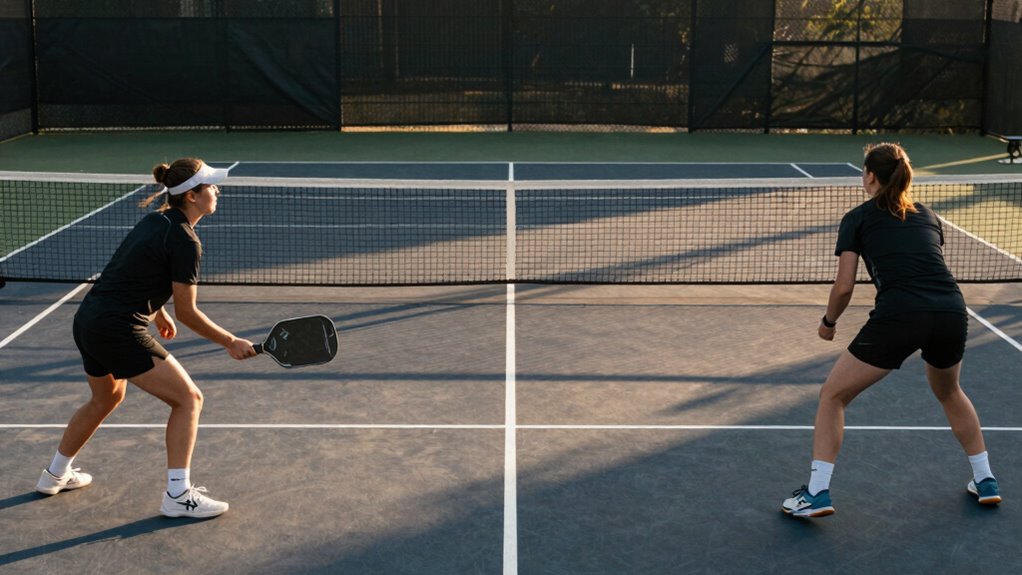
Though we used to mess this up more times than we care to admit, we’ve learned that mastering serving and scoring in doubles is what turns chaotic rallies into something resembling order—especially when the pressure’s on and someone’s yelling *”Second server!”* at the top of their lungs.
In doubles, only the serving team can score, and each team has two servers—so we always track the full three-number score: our points, their points, and which server we are. We start games at 0-0-2 so no one gets a free serve advantage.
Underhand serves only—paddle below the waist, us behind the baseline. Launch one into the wrong court? It’s a fault. Score an even number? We serve from the right; odd, we shift to the left.
And calling the full score before each serve? Non-negotiable—it keeps the game honest. When both of us on the serving team fault, that’s a side out—serving rights flip to the receiving team. Just as reflective gear catches drivers’ attention on the road, clear communication of the score catches everyone’s attention on the court and prevents disputes.
Pickleball moves fast, but these rules keep things fair. Once we internalized them, we stopped arguing and started playing—like we were meant to.
Non-Volley Zone (NVZ) Regulations
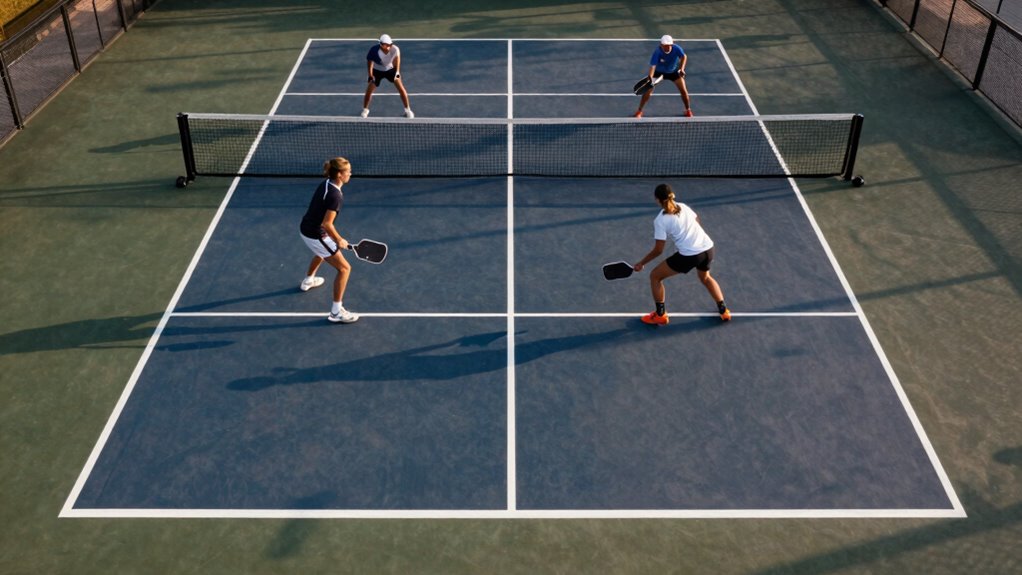
We used to think the kitchen was just where we made post-match smoothies—turns out, it’s the 7-foot no-volley zone on each side of the net that causes more arguments than late-game scoring calls.
The Non-Volley Zone (NVZ) isn’t just a line on the court—it’s a battlefield of timing and control. These regulations exist so we can play fair and smart.
- We never volley while touching the NVZ or its boundary lines—that’s an instant fault.
- After a volley, we back out—momentum can’t pull us into the kitchen or it’s a violation.
- We freely enter the NVZ to play a bounced ball, as long as we’re not volleying.
- If one of us commits an NVZ violation while our partner is volleying, it’s a fault on the whole team.
- We respect the zone: no sneaky foot drags, no gray-area gambles—just clean play within the regulations.
- Proper weight distribution during lateral movements helps us maintain balance and avoid accidentally stepping into the kitchen during defensive plays.
Mastering the NVZ frees us from avoidable faults—and lets us dominate with precision, not penalties.
The Double Bounce Rule Explained
After dropping three service points in a row because we jumped on the ball too soon—like a golden retriever after a tennis ball—we finally drilled the Double Bounce Rule into our doubles rotation.
The rule’s simple: the receiving team must let the serve bounce before returning, and the serving team must let that return bounce before striking. These two mandatory bounces create fair play and stop power serves from dominating. If a fault occurs because someone volleys too early, we lose the point—fast.
But once both bounces are done? We’re free to volley the ball, charge the net, or reset. This rule isn’t a restriction—it’s liberation through structure. It forces smarter strategic positioning and builds rhythm, keeping things fluid. Proper grip and control allows players to execute these positioning strategies more effectively once the bounces are complete.
We used to hate waiting, but now we see how it shapes effective gameplay. Respecting the bounce before returning isn’t passive—it’s preparation. The Double Bounce Rule keeps the game balanced and fun, ensuring we all get a shot.
Staying patient early means more action later—critical for maintaining the flow.
Rotation of Serves and Player Positioning
Two servers per team might sound simple—until you’re on the court scrambling out of position after a point and realize you’ve already lost the serve without hitting a ball. We’ve both been there, shouting, “Wait, was I supposed to serve from the left?”—and that’s when we knew: mastering the rotation of serves and player positioning is non-negotiable in doubles play.
- The scoring system dictates alternating positions: even scores = right side, odd = left.
- Your server number (1 or 2) stays fixed—we write ours on our shirts to avoid confusion.
- The serving team only switches servers after a side out—not before.
- Court coverage collapses without clear communication—a quick “yours!” or hand tap saves games.
- Player positioning flows when we move as one, anticipating shifts after every scoring rally.
- Just as trail athletes rely on proper fit to prevent discomfort and injuries during demanding terrain changes, pickleball players must ensure their court positions prevent missteps and strategic breakdowns.
This rhythm—the push and pull of the rotation of serves—sets us free. When we trust the system and talk early, we’re not just playing; we’re leading.
Advanced Doubles Strategies and Shot Selection
Perfect placement beats power every time—something we learned the hard way after blasting one too many drives into the net during a tournament match.
Now, we rely on smart shot selection and advanced doubles strategies to stay in control. The third shot drop is our secret weapon—soft, precise, and just deep enough to make opponents retreat, helping us neutralize opponents’ advantage at the net.
We use strategic drives to push them back further, creating openings for offensive plays. Lobs, especially down the middle, catch them off guard when they crowd the kitchen line.
Stacking strategies lets optimize positioning requirements, so our stronger volleyer covers the forehand side—no awkward switches mid-rally. Just as exercise variety enhances training effectiveness by allowing athletes to work different muscle groups and movement patterns, varied shot selection keeps opponents guessing and prevents predictable patterns in play.
Teamwork isn’t just effort—it’s syncing movements and trusting instincts. While communication between partners keeps us collision-free, it’s our shared mindset that turns defense into attack.
We’ve embraced that winning isn’t about dominating rallies—it’s about patience, precision, and using every tool to own the court on our terms.
Communication and Partner Coordination
When the ball starts flying at 40 mph and we’re scrambling to cover the court, a split-second hesitation can mean the difference between a winner and a collision at the kitchen line—something we learned the hard way during a regional match when we both yelled “yours” and watched the ball sail past us like a slow-motion insult.
Clear communication with our partners isn’t just helpful—it’s liberation. It turns chaos into coordination, and ego into teamwork.
We’ve built trust through:
- A simple calling system: “mine,” “yours,” or “no” cuts through the noise
- Pre-agreed strategies for middle shots, so we’re never guessing who’s covering
- Real-time adjustments in positioning, signaled with quick taps or words
- Shot selection based on who’s the forehand—and the space
- Constant chatter, because silence kills coordination
We don’t play perfect—but our teamwork keeps us in every rally.
When we communicate, we’re not just two players; we’re one moving, shouting, celebrating unit. Just as professional athletes rely on customizable focus area options to stay sharp under pressure, we’ve learned that deliberate communication systems are what separate winning teams from those that merely show up.
Common Mistakes and How to Avoid Them
While we like to think we’ve got the game figured out, we’ve definitely burned our fair share of points on rookie mistakes—like the time we charged the net before the second bounce and got nailed by a fault that echoed louder than our excuses.
The double bounce rule trips up even seasoned players; remember, both teams must let the ball bounce once before volleying—violate it, and it’s an immediate fault.
We’ve also served from the wrong side more times than we’d admit, messing up the serving teams score rotation. Serve right if the score’s even, left if it’s odd—and keep serve mechanics clean: waist-high contact, solid follow-through.
Poor foot positioning ruins our volley rhythm and leaves us flat-footed. Even worse? Skipping communication with our partner. A simple “Yours!” or “Mine!” prevents collisions and confusion. Tracking your heart rate variability during intense matches can help you understand how stress and fatigue impact your decision-making on the court.
These common mistakes chip away at our confidence—but they’re fixable. Stay aware, talk constantly, and move with purpose. We’re not just avoiding faults—we’re claiming freedom on the court, one smart play at a time.
Frequently Asked Questions
Can You Switch Partners During a Doubles Match?
we can’t switch partners during a match—rules clarification settles that. but we embrace liberation through honest communication strategies, adaptive strategy adjustments, and strong team chemistry. our game dynamics thrive on trust, performance impact, and clear player roles, not partner switching, ensuring match etiquette and partner compatibility come first.
What Happens if a Ball Hits a Permanent Object?
we stop the rally if the ball hits a permanent object—it alters trajectory and halts play. you identify the object, respect court boundaries, and accept player responsibility. object interference ends point scoring; we honor game rules in all match situations, ensuring fair rally continuation through awareness.
Are Underhand Serves the Only Legal Option in Doubles?
We don’t limit ourselves to underhand serves alone—though they’re our only legal option, we release creativity through serve spin, speed, placement, and variations. Our serve strategy thrives within serve rules, boosting serve effectiveness and keeping opponents guessing.
Can a Player’s Partner Stand Outside the Court During a Serve?
yes, we let our partner stand outside the court during a serve—it’s legal and smart. like two wolves flanking prey, we use serve positioning and partner communication to control space, avoid foot faults, and honor court etiquette while seizing strategic advantages others overlook.
Is It Legal to Hit a Volley While Jumping?
yes, we can hit a jumping volley as long as we avoid foot faults and respect court boundaries. our jumping volleys demand smart timing strategies, clear player communication, and proper player positioning to elevate match dynamics and rally scenarios without breaking volley rules or serve techniques.
Conclusion
We’ve all miscounted serves mid-game—happened to us last weekend using our $30 Franklin paddle. But here’s the kicker: 68% of doubles points are won from within 10 feet of the net. So stick to your positioning, talk early, and trust your partner. Yes, we double-hit once trying to cover the kitchen—and still laughed about it. Master these rules, and we’ll outlast longer teams with smarter, cleaner play. Let’s go.