We’ve all been there—that game where nothing clicked, where you replayed every mistake on the drive home. Here’s what we’ve learned: bouncing back isn’t about forgetting what happened. It’s about processing those emotions without letting them consume you, then strategically channeling that frustration into fuel. But here’s the thing most athletes miss—there’s a specific sequence to this recovery that actually works. Let’s explore what it is.
Key Takeaways
- Acknowledge your feelings and frustration without judgment, recognizing one bad game doesn’t define your entire athletic journey.
- Wait at least 12 hours before analyzing performance to allow emotional recovery and prevent spiraling negative thoughts.
- Focus on controllable factors like preparation, effort, and attitude while setting specific, measurable improvement goals.
- Review game film to identify mistakes and patterns objectively, maintaining your regular routine for stability and control.
- Reach out to coaches, teammates, family, or mentors for perspective, validation, and emotional support during recovery.
Acknowledge Your Feelings and Performance
When you’re sitting in the locker room after a terrible game—the kind where nothing clicked, your timing was off, and you made mistakes you can’t believe you made—it’s tempting to just shut down emotionally and pretend it didn’t happen. Don’t do that. We’ve learned that true mental toughness means acknowledging your feelings head-on, not burying them. Let yourself feel the frustration, the disappointment—those emotions are valid and deserve space. Here’s what we do: we sit with it for a moment, then we shift perspective. Yes, you underperformed. And yes, you showed up and competed. We recognize both truths simultaneously. Talk to a teammate or coach about what happened. Getting those feelings out of your head—into actual conversation—frees you, much like how quick access to supplies during emergencies can make all the difference in a crisis situation. One bad game isn’t your story. It’s just one chapter.
Allow Time for Reflection
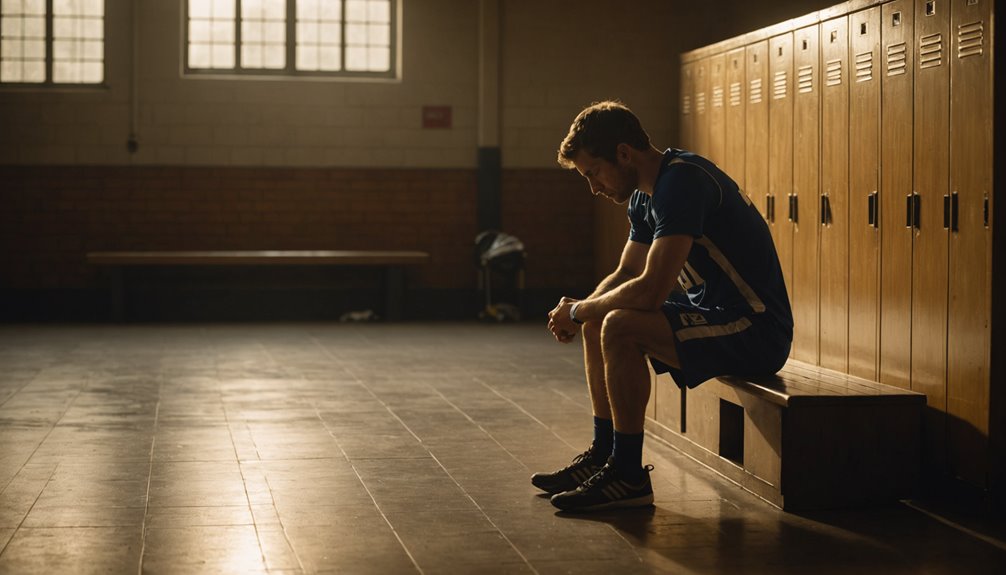
After that brutal loss, your instinct is to immediately dissect every mistake and create a game plan for redemption—we get it, we’ve been there. But here’s what we’ve learned: give yourself a full 12 hours before diving into analysis. This isn’t avoidance; it’s strategy.
During this reflection period, you’re processing frustration and disappointment without spiraling into negative thoughts. Your brain needs space to metabolize the emotional hit. We’ve found that athletes who pause actually bounce back stronger than those who obsess immediately. Just as adaptive workout intensity adjusts based on performance and energy levels, your mental recovery also requires time to recalibrate before pushing forward.
After those 12 hours? Then you shift gears. You’ve acknowledged the sting. You’ve sat with it. Now you’re ready to rewrite your narrative forward, diminishing rumination’s grip and building genuine resilience for what’s next.
Identify What You Can Control

Now here’s where the real work begins—because you can’t control the referee’s call, the wind, or your opponent’s hot streak, but you absolutely can control what happens next. We’re talking about mental performance that actually matters. Your preparation, attitude, and effort? Those are yours to own.
| Controllable | Uncontrollable | Action | Result |
|---|---|---|---|
| Practice intensity | Weather conditions | Increase reps | Skill improvement |
| Game preparation | Crowd noise | Film review | Better decisions |
| Effort level | Official judgment | Train harder | Confidence boost |
| Attitude | External criticism | Focus inward | Mental clarity |
We’ve learned that separating what’s in your power from what isn’t creates freedom. You can’t change yesterday’s performance, but you can absolutely refine your technique today. Channel that frustration into controllable actions—extra drills, mental visualization, tactical adjustments. Tracking your recovery metrics and sleep quality can help you understand how your body responds to intense training and guide your comeback plan. That’s how we bounce back stronger.
Watch Film to Learn From Mistakes
Because your memory of what happened on the field is almost always incomplete—clouded by adrenaline, emotion, and the tunnel vision that comes with competition—film becomes your honest mirror. We’ve all walked off thinking we crushed it, only to watch footage revealing completely different reality.
Film review transforms a bad performance into actionable intelligence. You’ll spot decision-making patterns you missed during play, seeing exactly where you hesitated or overcommitted. That’s liberation right there—concrete evidence replacing fuzzy regret.
We recommend breaking down specific plays frame-by-frame. Notice your footwork, your reads, your positioning. Track consistent mistakes across multiple possessions. This isn’t about self-flagellation; it’s about collecting data. Just as athletes benefit from reviewing detailed terrain information to understand their environment, reviewing film with structured analysis reveals patterns that emotion alone cannot capture.
Recognize your strengths too. You’ll spot moments where instinct worked perfectly, techniques that landed clean. Progress compounds when we study both wins and losses equally.
Focus on Your Strengths
When you’re replaying that interception or missed assignment on loop, your brain’s already convinced you’re terrible—and we’ve all been there. But here’s what we’ve learned: shifting toward your strengths isn’t ignoring what went wrong; it’s building the mental foundation you need to improve. Identify at least three things you nailed during the game. Did you execute that coverage read perfectly? Land a crushing block? Show up mentally when it mattered? These wins matter—they’re proof you’ve got the skills. We’ve found that anchoring yourself in what you do well creates resilience. You’re not delusional; you’re strategic. This strengths-based approach quiets the noise, steadies your confidence, and gives you something solid to build upon. Consider tracking your performance metrics with heart rate and recovery stats to identify patterns in your mental and physical performance during games. That’s how we break free from the shame spiral and actually grow.
Set Realistic Improvement Goals
The gap between “I played badly” and “I’m going to fix this” is where most players get stuck—we’ve seen it happen countless times. That’s why we need to set realistic improvement goals instead of vague promises. Pick one specific skill: shooting accuracy, defensive positioning, ball handling. Then aim for incremental progress—say, a 5% shooting increase over your next five games. Make it measurable. Collaborate with your coach; they’ll keep you honest. Establish short-term targets like completing fifteen drill repetitions daily. Review your progress weekly. Adjust when necessary. This framework breaks the paralysis cycle. You’re not fixing everything overnight—you’re building momentum through small, deliberate wins. That’s how champions actually bounce back. Just as proper equipment fit enhances a young athlete’s confidence and performance in sports, the right mental framework and achievable goals will transform your comeback from frustration into genuine progress.
Engage in Activities Outside Your Sport
After you’ve crushed yourself analyzing game film and drilling corrections until your legs ache, it’s time to do something radical: stop thinking about basketball altogether. We’re talking leisure activities—hobbies, hangouts, anything that isn’t your sport. This mental recovery matters more than you’d think.
When you step away, your brain resets. You gain perspective that film study won’t give you. Spend time with friends or family; their support keeps you from spiraling. Pick up that guitar collecting dust. Hit the arcade. Cook something. These activities aren’t distractions—they’re fuel. Consider pairing your recovery time with physical activities like running, which can be enhanced with Bluetooth headphones for seamless audio during your workout.
Athletes who balance their sport with genuine interests develop resilience that carries them through tough seasons. You’ll return sharper, more creative, and motivated. That bad game? It’ll sting less when you’ve lived a little outside it.
Maintain Your Daily Routine
Your routine is your anchor—especially when your confidence is shaky. We’ve found that sticking to our daily life after bad games actually frees us from spiraling thoughts. When you maintain regular workouts, meals, and practice sessions at consistent times, you’re telling your mind: *this setback doesn’t define everything*. That structured environment isn’t boring—it’s liberating. You’re reclaiming control.
We recommend scheduling specific activities alongside your training. Maybe it’s your 6 a.m. run, your team’s 2 p.m. session, or evening study time. These anchors prevent obsessing over mistakes. Plus, routine keeps you connected to teammates during recovery—that social support matters tremendously. You’re not withdrawing into shame; you’re staying engaged, staying present. Like multi-functional gear, a well-structured routine serves multiple purposes in your recovery, addressing both mental and physical needs simultaneously.
Bad games lose their power when they’re just one part of your day, not the entire story.
Lean on Your Support System
When isolation creeps in after a rough performance, that’s precisely when we need people most—yet it’s exactly when we want to disappear.
That instinct to hide? We’ve all felt it. But here’s what we’ve learned: reaching out to your support system—friends, family, coaches—isn’t weakness. It’s strategy. These people offer emotional comfort and perspective we can’t manufacture alone. Just as immersive technology enhances engagement and motivation in fitness experiences, connecting with your support system strengthens your mental resilience during difficult times.
| Who to Contact | Why They Matter | What They Provide |
|---|---|---|
| Coaches | Understanding the sport | Technical insight, encouragement |
| Teammates | Shared experience | Validation, community |
| Family | Unconditional support | Grounding, perspective |
| Close friends | Outside perspective | Distraction, normalcy |
| Mentors | Wisdom from setbacks | Long-term resilience |
Conversations about our feelings reduce stress considerably. Engaging with loved ones—grabbing coffee, shooting hoops—helps our minds reset. We’re not alone in struggling. That recognition? It’s liberating.
Prepare With Confidence for Your Next Competition
Once you’ve got your people in your corner—and they’re there listening—it’s time to shift your focus forward. We’ve found that preparing with confidence for peak performance isn’t about erasing what happened; it’s about channeling that disappointment into fuel. Start by visualizing success—actually see yourself executing those plays perfectly. Set specific goals for your next competition. Maybe it’s nailing free throws or reducing turnovers by fifteen percent. We recommend developing a pre-game routine that includes positive affirmations. Yes, it sounds simple, but repetition rewires your brain. Target practice sessions on your weaknesses. Recall past victories when doubt creeps in. You’ve succeeded before; you’ll do it again. That’s not wishful thinking—that’s evidence-based confidence. Between competitions, incorporate foam rolling into your recovery routine to reduce muscle soreness and improve flexibility, ensuring your body is primed for peak performance.
Frequently Asked Questions
How to Bounce Back From Bad Games?
We’ll bounce back by acknowledging our frustration, then shifting toward mental resilience through honest performance analysis. We’re building a positive mindset by reviewing footage, celebrating our strengths, and reconnecting with our community. We’re free to learn and grow from this.
How to Cope After a Bad Game?
We cope by embracing self-reflection techniques that build emotional resilience. Let’s acknowledge our feelings honestly, then use film analysis to learn. We’ll reconnect with our community, engage in activities we love, and reclaim our confidence—because we’re not defined by one game.
How to Bounce Back After Losing a Game?
We’re breaking free from defeat by using self-reflection techniques and positive affirmations—like sending a telegram to our future selves. We’ll acknowledge our emotions, identify three wins, then liberate ourselves through gameplay analysis and unrelated activities that restore our confidence.
How Do I Let Go of a Bad Game?
We’ll let go by practicing self-reflection techniques that build emotional resilience. We’re acknowledging our feelings, setting a 12-hour processing limit, then redirecting our energy toward controllable factors. We’re freeing ourselves through action, not dwelling—that’s how we reclaim our power.
Conclusion
We’ve tested this framework—it works. Bad games don’t define us; our response does. You’ll bounce back faster when you process emotions honestly, learn from film, and trust your preparation. That next competition isn’t punishment—it’s your comeback stage. We’re all one solid performance away from momentum shifting. Stay disciplined with your routine, lean on your people, and remember: every elite athlete you admire has stumbled. They simply got back up.