We’ve all had that moment—you wander fifty yards from camp for firewood, and suddenly nothing looks familiar. Here’s what we understand works: panic’s your real enemy, not the forest. We’ll walk you through the STOP method, show you how to signal for rescue, and share the survival moves that’ve gotten us out of tight spots. But first, you need to know what your instincts are getting wrong.
Key Takeaways
- Stop immediately and take deep breaths to calm your nervous system and think clearly about your situation.
- Use the STOP method: Stop moving, Think about landmarks, Observe surroundings, and Plan your next action carefully.
- Look for familiar landmarks or terrain features you recognize from your route to retrace your steps methodically.
- Signal for help using three whistle blasts or visual markers to alert nearby campers or rescuers.
- Stay put near camp rather than wandering; conserve energy, stay hydrated, and wait for discovery by others.
Stay Calm and Assess Your Situation
When panic starts creeping in—that tight-chest feeling when you realize the trail behind you looks nothing like you remember—that’s actually your cue to stop moving and take three deep breaths.
We’ve all been there. Your heart races, your mind spins, and suddenly every direction feels wrong.
Here’s the truth: staying calm isn’t about feeling fearless; it’s about reclaiming control. Pause right now. Breathe deeply—in for four counts, out for four counts. This simple act flips your nervous system from fight-or-flight to thinking mode.
Next, assess your surroundings carefully. Look for landmarks: that distinctive boulder, the creek bend, the ridge line.
We’re not moving yet; we’re observing. Spot trees you recognize? Notice the sun’s position? These details anchor you. They transform a scary situation into a solvable puzzle. A compact first-aid kit and other essential safety items in your pack can provide reassurance during uncertain moments. You’ve got this.
Use the STOP Method to Think Clearly
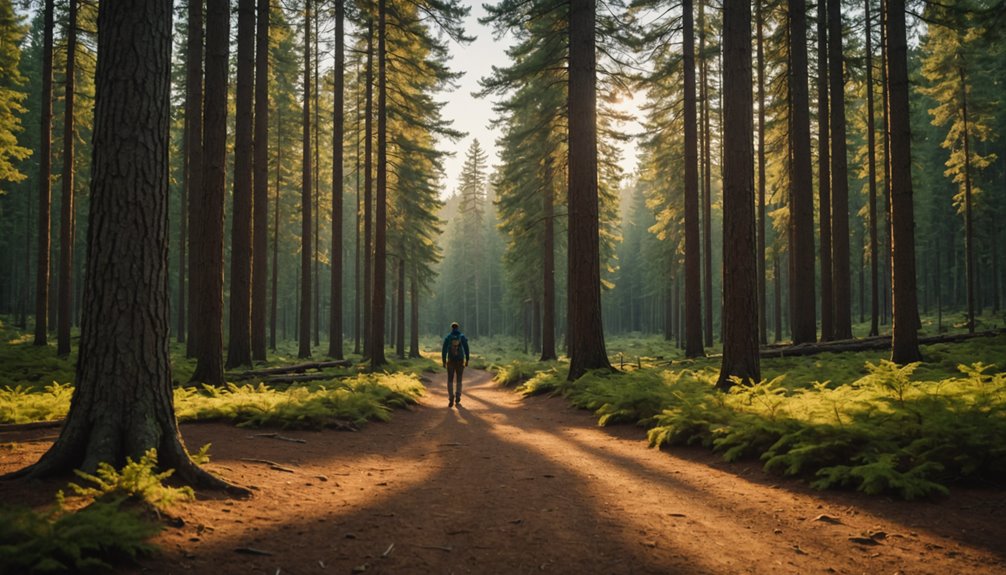
Now that you’ve caught your breath and spotted some landmarks, it’s time to deploy a framework we’ve used countless times in the backcountry—the STOP method.
Here’s how we break it down: Stop moving immediately—don’t wander aimlessly when getting lost.
Think clearly about what you know: landmarks you recognize, the direction you came from, distance traveled.
Observe your surroundings methodically, noting terrain features and familiar sights.
Plan your next move thoughtfully. Sometimes staying put beats risky navigation; we’ve learned this lesson repeatedly.
Ask yourself honestly: can you confidently retrace your steps, or should you remain visible for rescuers? Having a well-equipped first aid kit in your pack ensures you’re prepared for minor injuries while you wait for help to arrive.
This tactical pause—usually five to ten minutes—transforms panic into purposeful action.
We’ve found that disciplined thinking saves us every time.
Look for Familiar Landmarks Near Camp
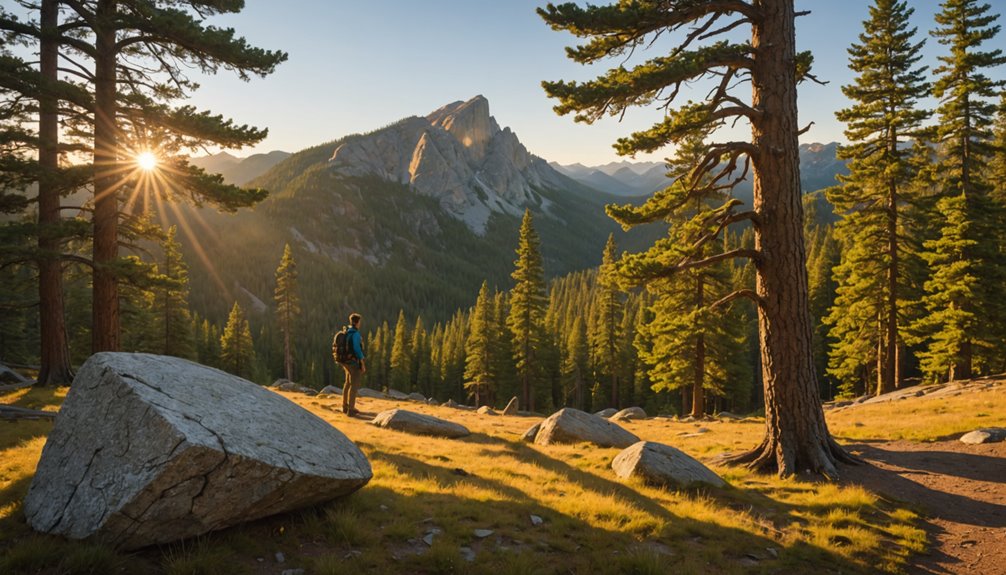
Since you’ve already applied the STOP method, your mind’s sharper now—so let’s put it to work.
Go back mentally to your last known location and scan for distinctive markers you remember passing. That gnarled oak with the split trunk? Those stacked rocks? They’re your breadcrumbs home.
We’ve all frozen mid-trail, wondering which direction we came from.
Here’s what actually works: study the terrain’s contours—slopes, valleys, water flow patterns. They rarely lie. Check the sun’s position or note which way the wind’s pushing.
If you’re close enough, listen for campfire sounds or smoke wisps; they’re lifelines when landmarks blur together. While waiting to be found, applying insect repellent to exposed skin will keep you comfortable and focused during your time near camp.
Don’t rush. Methodically connect these visual cues like dots. Your memory’s already primed from the journey out—trust it.
Retrace Your Steps Carefully
Once you’ve spotted a landmark or two, the real work begins—and it’s slower than you’d think. We’ve all rushed back to camp only to overshoot the trail. Don’t repeat that mistake. Move deliberately, scanning for the subtle markers you passed the last time you walked this route. Consider using bright colors or reflective markers to make your trail easier to spot in low-light environments.
| Action | Why It Works | What to Watch |
|---|---|---|
| Move slowly | Catches missed signs | Rock cairns, blazes |
| Use compass | Prevents circles | Confirms direction |
| Mark your path | Aids rescuers | Stick arrangements |
| Reference landmarks | Builds confidence | Trees, ridges |
| Check map | Confirms location | Terrain features |
We retrace methodically, not frantically. Your map and compass become trusty companions here. Drop sticks or arrange rocks every twenty feet—they’re breadcrumbs for both you and potential rescuers. You’ve got this.
Signal for Help With Noise and Visibility
Three things’ll get rescuers to you faster than anything else: sound, sight, and smart signaling.
We’ve found that a whistle carries roughly ten times farther than shouting—it’s physics, not magic. Blast three short bursts every few minutes; rescuers recognize this universal distress pattern. Emergency whistles can produce sound output over 100 decibels, making them significantly more effective than your voice alone.
Between whistle signals, bang sticks together or yell periodically to maintain your signal’s visibility in searchers’ minds.
For sight, wear your brightest gear high—drape it across branches where helicopters’ll spot it. Create unmissable ground-to-air markers using rocks or logs arranged into “SOS” or directional arrows. These signal intent clearly.
On sunny days, reflective materials become gold. A mirror, water bottle, or even a phone screen bounces light effectively across distances. We’ve tested this; it works.
Combine these methods. Sound alerts nearby teams; visibility guides them in. You’re not panicking—you’re strategically broadcasting your location.
Create Visible Markers for Rescuers
Create visible markers using whatever you’ve got. Arrange rocks or logs into massive SOS letters or arrows pointing toward your location—make them at least ten feet across so aerial teams spot them.
Wear your brightest gear; that neon jacket isn’t fashionable, it’s lifesaving. Grab any reflective materials—mirrors, foil, phone screens—and angle them toward the sky for sun glints that catch rescuers’ attention from miles away.
Mark your trail back to camp with sticks and stones. Getting found depends on searchers following your breadcrumbs. Stack rocks at intervals, creating unmistakable markers they can’t miss.
Keep a portable fire extinguisher accessible in your camp kit so rescuers can locate you by smoke signals or to help manage any fires near your location during the rescue operation.
Build a Fire for Warmth and Detection
While staying visible matters, staying warm matters more—and here’s the thing: a fire does both.
We’ve found that a solid fire serves double duty: it radiates warmth when temperatures drop, and Search and Rescue teams can spot smoke from miles away during daylight. That visibility? Priceless.
Start by gathering tinder—dry leaves, bark, small twigs—then kindling, then arm-sized fuel wood.
Clear a small area, ring it with stones to contain the blaze, and you’re golden. If you’ve got a fire starter or matches, light the tinder bundle first. Feed larger pieces gradually; patience pays off here.
Keep flammable materials back, watch it closely, and fully extinguish everything before you leave. LED lanterns with adjustable brightness can also supplement your fire for additional safety lighting if available in your gear.
We’ve learned that a managed fire isn’t just survival—it’s freedom from panic.
Hang Brightly Colored Clothing as a Signal
Your bright jacket or that neon bandana in your pack? They’re your ticket to being found.
We’ve learned that hanging brightly colored clothing in trees—particularly in open areas—makes us visible from helicopters and ground teams searching from distances we can’t imagine.
Here’s what works:
- Choose high-contrast colors like orange or fluorescent yellow that pop against green foliage
- Position items 8-10 feet high where dense branches won’t hide them
- Secure everything tightly so wind won’t scatter your signal
- Combine clothing with reflective emergency blankets for maximum visibility
We’re talking about survival, not fashion.
That old neon jacket you’d normally ditch? It’s now your freedom beacon.
Search teams scan treetops constantly. By hanging brightly colored clothing strategically, you’re fundamentally saying, “I’m here.” You’re taking control of your rescue. Emergency thermal blankets can reflect up to 90% of body heat back to you while also serving as highly visible signaling devices when hung alongside your clothing.
Set Up Shelter and Conserve Resources
Once you’ve signaled your location, it’s time to focus on the fundamentals—shelter, water, and food—because staying alive until rescue arrives depends on managing what you’ve got.
We prioritize a makeshift shelter using branches and evergreen boughs for insulation against wind and rain. Layer ferns underneath for ground protection; trust us, staying dry matters more than comfort. Consider wearing waterproof gaiters during extended stays in wet conditions to protect your feet from moisture and debris while you work on shelter construction.
Next, locate clean water nearby—a stream within earshot works perfectly. Drink small amounts regularly rather than chugging; dehydration sneaks up fast.
Build a contained fire outside your shelter for warmth and visibility, keeping it away from dry materials.
Ration your food strictly: small portions maintain energy without depleting supplies.
We’ve learned that discipline here—not panic—determines survival.
Stay Hydrated and Rest While Waiting for Rescue
As the adrenaline fades and you settle into your makeshift shelter, hydration becomes your single most important task—we can’t stress this enough because dehydration clouds judgment faster than panic ever could.
We’ve learned through experience that staying hydrated means drinking at least half a liter every couple hours, not when you’re parched.
Here’s what we recommend:
- Drink water consistently throughout your wait—don’t ration it like you’re crossing a desert
- Purify any water using boiling or tablets to avoid illness that’ll drain your remaining strength
- Rest in a comfortable position, minimizing movement that accelerates fatigue
- Focus your energy on hydration and rest rather than food searches
- Consider keeping a portable power station nearby at camp so you can charge devices for signaling rescuers with flashlights or emergency beacons
Your body’s preservation matters more than exploration.
Rest conserves energy. Hydration keeps your mind sharp for rescuers.
Frequently Asked Questions
Should You Stay Put if You Get Lost in the Woods?
Yes, we recommend you stay put when lost in the woods. We’ll signal help through visible markers like fires or SOS formations. Staying put conserves our energy, increases our chances of rescue, and prevents us from wandering deeper into unfamiliar territory where we’re harder to find.
Where Do Most Hikers Go Missing?
Most missing hikers meander through unmarked, mysterious trails where we’re vulnerable to disorientation. We’ve found that venturing solo sans signage considerably complicates search efforts. Wayward wanderers who won’t stick to planned paths make rescue operations more difficult for teams seeking our freedom-seeking friends.
What Are the 5 C’s of Survival?
We’ve got five essentials: cutting tools for shelter building, combustion devices for fire, cover for protection, containers for water, and cordage for securing structures. Master these, and we’re free to explore wilderness confidently, armed with practical navigation skills and self-reliance.
What Is the 20% Rule for Backpacking?
We follow the 20% rule for backpacking essentials: carry no more than 20% of our body weight. This liberates us from excessive burden, sharpens our navigation skills, and lets us move freely through wilderness without physical strain limiting our freedom.
Conclusion
We’ve walked you through getting unlost—and honestly, staying calm’s your compass when panic’s your worst enemy. You’ve got this: use STOP, signal smart, conserve what you’ve got. We’ve been there, heart pounding, wondering which way’s home. But here’s the thing—you’re not truly lost if you remember you’re a problem-solver. Stay put, stay visible, stay hydrated. Rescue’s coming. You’ll make it back to camp.